
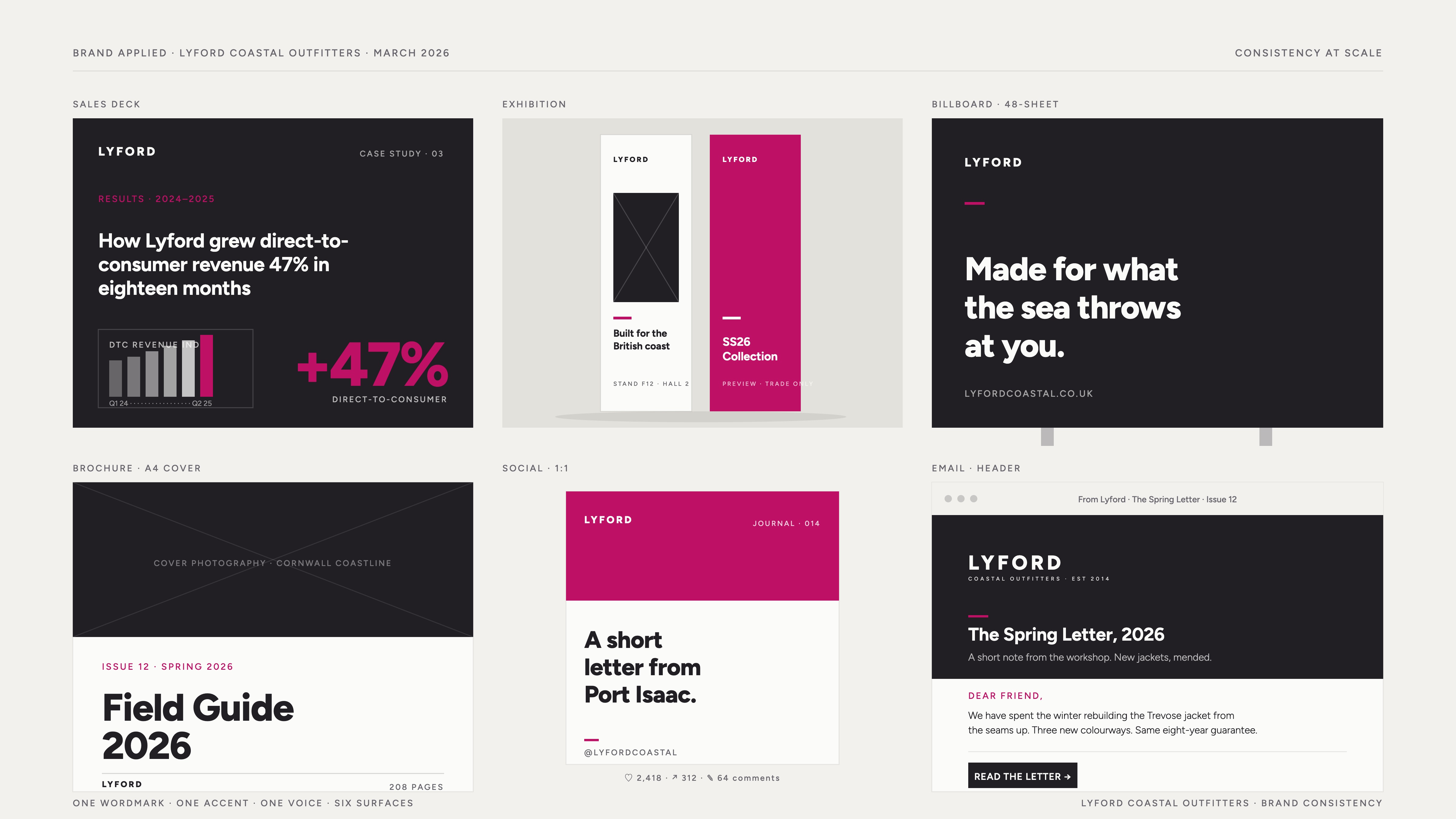
Brand Design System Implementation for Sales, Events and Print

Your brand guidelines live in a PDF that nobody reads. Your design templates live in a Figma library most of the business cannot open. Your sales team builds presentations in PowerPoint that drift further from the brand every quarter. Your events team commissions print that needs three rounds of correction. Your billboards launch without anyone seeing them outside design review.

We replace that with a unified AI powered brand design system. Sales prompt the system for a deck section and get on brand slides. Events prompt for a signage layout and get print ready output. Marketing prompt for a billboard concept and get a brand consistent execution to review. The brand holds across every surface because the system enforces it at the point of creation, not after the asset ships.

What you get:

  • A unified AI powered brand design system covering sales decks, events, advertising, print and out of home
  • Prompt frameworks any team member can use without design training
  • Brand guideline enforcement at the point of generation, before any asset reaches review
  • Senior design oversight built into the workflow for high stakes outputs
  • One source of brand truth across every team, every channel and every format

Why brand consistency breaks at scale

Every team produces assets. Sales builds decks. Events builds signage. Marketing builds campaigns. HR builds recruitment material. Procurement builds supplier packs. None of them are designers. All of them produce assets that need to look like they came from one brand. They never do.

What a unified design system looks like

One AI powered system every team can use. Trained on your brand guidelines, your colour palette, your typography, your image grading and your design templates. Output is brand consistent the moment it generates. Senior design reviews high stakes work. The brand holds across every surface because the system enforces it.

What the system covers

Sales decks and pitch templates. Event signage, exhibition stands and conference assets. Print collateral, brochures, leaflets and packaging. Out of home advertising including billboards, transport and retail point of sale. Internal communications. Recruitment and employer brand assets. Anywhere the brand needs to show up, the system covers.

Why Claude is the brain

Generating designs is straightforward. Generating designs that respect a brand system is hard. Claude reads the brief, interprets the brand context, selects the right template, populates it with on tone copy and reviews against brand rules. The output is design as a service, not design as a wild card.

For sales teams

Sales prompt the system for a deck section on a specific topic, with a specific audience and a specific outcome. The output is on brand slides ready for the call. Sales stop building decks in PowerPoint that drift from the brand. Marketing stop chasing sales for compliance.

For events teams

Events prompt the system for signage, stand layouts, conference programmes and exhibition collateral. The output is print ready, brand consistent and dimensionally accurate for the production partner. Events stop reinventing the brand for every show.

For advertising and out of home

Marketing prompt the system for billboard, transit and retail point of sale concepts. The output is in brand, in format and ready for production review. Concepting time drops from weeks to days. Senior design focuses on the big idea rather than the execution grunt work.

For internal communications

HR, internal comms and recruitment teams prompt the system for newsletters, employee material, employer brand assets and internal campaigns. The brand shows up internally with the same consistency it shows up externally. Culture and brand stop being separate conversations.

Brand guideline enforcement at generation

The brand rules are not a PDF nobody reads. They are configured into the generation layer. Outputs that breach the rules are flagged before they reach the team. The system cannot produce off brand work because the foundation will not let it.

Senior design oversight for high stakes

Not every asset needs a senior designer. A sales deck section can ship. A billboard cannot. The workflow distinguishes between routine output and high stakes work, routing the second to senior design review automatically.

Built for brands at scale

This works for any business where multiple teams produce assets that need to look like one brand. Particularly powerful for businesses with regional teams, distributor networks, franchise models or multi market operations where brand drift is the constant battle.

Built for category leading brands

For brands that compete on consistency and recognition, the system is a competitive asset. Every touchpoint reinforces the brand. Every team becomes a brand custodian. Every interaction with the brand strengthens it.

One source of brand truth

The brand guidelines, the templates, the asset library, the typography and the colour palette all live in one configured system. Updates roll out automatically. The brand evolves as one rather than fragmenting across teams and tools.

Built on fifteen to twenty years of agency depth

This is not a tool we have wired up. It is a system built on the brand expertise our agency has accumulated over fifteen to twenty years. The brand thinking, the design rigour and the prompt frameworks are encoded into the system.

Time to first asset

Sales prompt at 10am and have a deck section by 11. Events prompt for signage at the start of the week and have print ready output by Tuesday. Marketing prompt for a billboard concept on Monday and review live options by Friday. The brand moves at the pace the business demands.

Cost per asset

The marginal cost of a brand consistent asset drops dramatically. The team stops weighing whether a request is worth the design ticket. The brand starts showing up everywhere it should, including the touchpoints that used to get skipped because design capacity could not stretch.

Print and physical production ready

The system outputs in formats production partners need. CMYK colour profiles, bleed allowances, dimensional accuracy for stands and signage, print ready PDF. Your production partners stop receiving assets that need rework before they go on press.

Configured for your design infrastructure

The system integrates with Figma, Canva, Adobe Creative Cloud and your DAM. It sits on top of the design infrastructure you already pay for rather than replacing it. Your design team's existing investment compounds rather than gets discarded.

Why Teylu, and not a brand consultancy

Brand consultancies write guidelines. We turn guidelines into systems. A written guideline gets read once and ignored. A system enforces the brand every time anyone produces an asset. The difference is the consistency the business actually achieves.

Why Teylu, and not a design tool

Design tools generate output. They do not enforce a brand system. Without configuration, training, prompt frameworks and oversight, the output drifts. We build the system around the tools so the brand holds at scale.

Typical timeline

Six to ten weeks from discovery to a working unified design system. Phase one configures the brand foundation and the design system. Phase two builds the prompt frameworks for priority teams. Phase three embeds the workflow and trains the teams that will use it.

Engagement model

Fixed scope system build, then ongoing retainer for evolution as the brand evolves, the team grows and the channels expand. Most brand led clients move to retainer because the system needs to keep up with brand decisions.

See the systems in action

See the brands using a Teylu built brand design system to hold the brand across sales, events, advertising and print at scale.

Brief Us
Brief Us

This is built for businesses where the brand is a competitive asset, multiple teams produce brand assets and consistency is the constant battle. That usually means:

Category leading brands where consistency and recognition matter to commercial performance.

Multi team businesses where sales, events, marketing, internal communications and recruitment all produce brand assets independently.

Regional, distributor or franchise models where brand drift across geographies or partners is a constant management challenge.

Scaling businesses outgrowing the founder led design model and needing a brand system that scales with them.

Step 1: Brand and design audit

Week 1 to 2

We audit your current brand guidelines, design templates, asset library and the teams that produce brand assets. We document the gaps, the inconsistencies and the priorities.

Outcome

A documented brand and design audit. You know exactly what the system will be built on, what gaps need filling and which teams will see the first benefit.

Step 2: System build and configuration

Week 2 to 5

We configure the brand foundation, the design system, the template library and Claude as the brief interpretation and brand safety layer. We integrate with your existing design tools.

Outcome

A working design system configured to your brand and integrated with your design infrastructure. Tested on real briefs against your existing assets for quality comparison.

Step 3: Prompt frameworks and team rollout

Week 5 to 8

We build the prompt frameworks for priority teams, train the teams, configure the senior design review workflow and document the operating pattern. Adoption is the work in this phase.

Outcome

A unified design system in active use across sales, events, marketing and other priority teams. Brand consistency tightens. Production time drops. Senior design focuses on the big work.

Step 4: Extend and evolve

Week 8 onwards

We extend the system to new teams, new channels and new formats as the business expands. We evolve the brand foundation as the brand evolves. The system compounds in value.

Outcome

A brand design system that scales with the business, a brand that strengthens rather than erodes at scale and a creative team free to focus on the work that needs human judgement.

Book a discovery call

Tell us about your brand, your teams and the production volume you are managing. We will tell you whether a unified design system is the right next move.

Brief Us
Brief Us

Three tiers, sized to where your brand operation is today.

Brand Design Audit (entry tier)
A two week audit of your current brand, design templates and team workflow. You leave with a written readiness plan and a system build estimate.

Implementation (core tier)
Six to ten week build of the unified design system, the prompt frameworks and the team rollout. Senior design oversight embedded throughout.

Embedded Brand Design Labs (ongoing tier)
Monthly retainer with our brand and design team continuing to evolve the system, extend the frameworks and support the senior design review.

Pricing is transparent and sized to your brand complexity. Talk to us.

We have built brand systems that hold

The unified brand design system is shipped work for clients across multiple sectors. Every claim on this page is grounded in production work, not capability speculation. If you want to see one in action, we will arrange it.

Talk to the Brand Design team

If your brand is fragmenting across teams and surfaces, and the design team cannot keep up with demand, this is built for you. Tell us where you are and we will tell you whether a unified system is the right move.

Talk to the Brand Design team

Speak to a senior member of our brand and design team. We will scope a discovery in the call and give you a clear next step.

Brief Us
Brief Us

Will the system replace our design team?

No. It supports them. The system handles the routine production volume the team cannot personally produce. Senior design focuses on the high stakes work, the brand evolution and the creative direction. The team's best work compounds rather than gets diluted.

Does this work for print and physical production?

Yes. The system outputs in formats production partners need: CMYK colour profiles, bleed allowances, dimensional accuracy for stands and signage, print ready PDF. Your production partners stop receiving assets that need rework.

How is the brand kept safe at scale?

Brand rules are configured into the generation layer. Outputs that breach are flagged before they reach the team. High stakes work routes to senior design review automatically. The brand strengthens at scale rather than diluting.

Will the sales team actually use it?

Yes, because the experience is designed for them, not for designers. Sales prompt for a deck section on a specific topic and audience, get on brand slides back in minutes and ship them straight to the call. Adoption follows utility.

How does this integrate with Figma, Canva and our existing design tools?

It sits on top. The system integrates with Figma, Canva, Adobe Creative Cloud and your DAM. The investment in your existing design infrastructure compounds rather than gets discarded.

Speak to the team

Have a question we have not answered? Tell us. We will give you a straight answer, not a pitch.

Brief Us
Brief Us

Reach out and let’s do something remarkable together.

Contact Us
Contact Us