
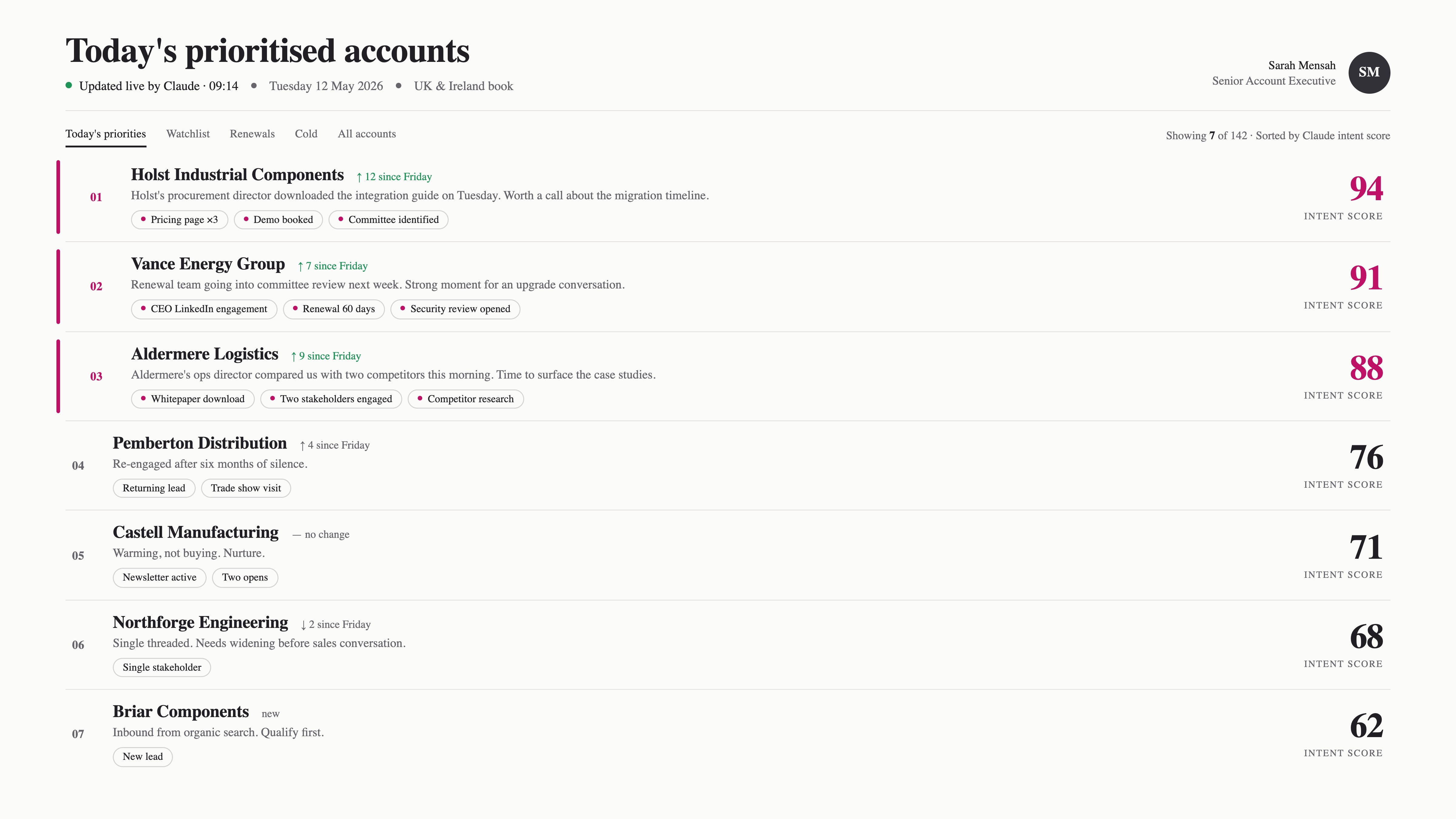
AI Live Lead Scoring and ABM Intelligence

Most B2B sales teams open the day to a stale list and a guess. Lead scoring built last quarter, account intelligence buried in five tabs, and pipeline that does not reflect what buyers actually did last week. We replace that with a live Claude powered scoring engine that updates continuously and ranks every account, every contact and every opportunity by the signals that actually predict revenue.

This is the same engine we have shipped for HMS and Arrow ECS. Sales open the dashboard, see the top conversations for the day with context Claude has surfaced, and start the morning on the highest probability work. Marketing earns trust because the leads it hands over convert. The board gets a forecast it can defend.

What you get:

  • A live lead and account scoring model that updates as new behaviour, intent and firmographic signals come in
  • Account based marketing intelligence at the contact, account and parent account level
  • A daily prioritised list for every sales rep, with the context to open the conversation
  • A closed loop feedback mechanism so every accept and reject from sales sharpens the model
  • Compliant deployment on AWS Bedrock UK South with documentation your governance team can defend

Why lead scoring breaks in B2B

Most lead scoring is static. It was built once, against a small training set, and never adapts. It uses crude rules like job title and company size. It cannot weigh behaviour against intent. It cannot reason about whether three page views, one webinar registration and a competitor mention add up to a buyer. So sales loses faith and reverts to gut feel.

Why live scoring with Claude works

Claude reads the full pattern. It looks at behaviour, intent, account hierarchy, recent news, sales notes and pipeline history together. It updates scores continuously as new signals arrive. It explains why a score moved, in language a sales rep can act on. The model is not a black box. It is a working assistant your team can trust.

Account based scoring, not just lead scoring

For ABM teams the unit of value is the account, not the lead. We score at the account level, parent account level and contact level. We surface the buying committee where it forms. We weight champions, blockers and economic buyers differently. The result is account level intelligence your sales team can act on with confidence.

The signals we score against

Web behaviour, email engagement, sales conversations, intent data, news mentions, funding events, hiring signals, technology stack changes, content downloads and any first party signals your business already captures. We integrate with G2, Bombora, ZoomInfo and Apollo where you already have feeds. We also accept custom signals you have proprietary access to.

The daily prioritised list

Every sales rep opens the morning to a ranked list of accounts and contacts ready for a conversation. Beside each entry sits the context Claude has surfaced: the latest engagement, the relevant news, the buying signal that lifted the score, and a suggested opening. The rep stops looking for the work. The work is in front of them.

The closed loop with sales

Every accept, every reject, every closed won and closed lost outcome feeds back into the model. The scoring sharpens with every sales cycle. The marketing team sees which signals predict revenue and which do not. The friction between sales and marketing dissolves because both teams work from the same evidence.

For RevOps leaders

You get a forecasting layer the board can defend. Pipeline coverage is measured against real intent, not opportunity stage theatre. The model identifies stuck deals, single threaded conversations and renewal risk before the sales team does. Forecast accuracy lifts because the signals beneath it are honest.

For ABM marketers

You get account level visibility into which campaigns warm accounts, which content moves committees, and which channels produce buying intent rather than vanity engagement. You can finally show the board the return on the ABM investment with evidence rather than narrative.

Built to compound

Static scoring decays. Live scoring compounds. Every cycle, every closed deal, every sales feedback signal feeds the model. Three months in, it is sharper than the day you launched. Twelve months in, it is the single most accurate predictor of revenue in your business.

Built compliant

The model runs on Claude through AWS Bedrock UK South. Data stays in UK jurisdiction. We deliver a documented model card, decision logic, audit trail and human oversight points. The 2 August 2026 EU AI Act high risk obligations and the ICO AI Code of Practice are designed in from day one, not bolted on later.

How we built it for HMS Networks

HMS Networks sales teams used to chase the loudest leads. Now they open a Claude powered prioritised list every morning, with account context, recent engagement and a clear next action. Win rates lifted because the conversations match the intent. The marketing team finally has a feedback loop it can prove value through.

How we built it for Arrow ECS

Arrow ECS runs complex multi region account based motions across technology partners. We built a live account scoring engine that weighs partner activity, account hierarchy and intent signals together. The sales team gets one prioritised view across regions. Marketing finally proves account based programmes against pipeline produced.

What changes for sales

The list is ranked. The context is surfaced. The opening is suggested. Sales reps spend more time in conversations and less time hunting for them. Forecasting becomes credible because the pipeline is built on signal, not optimism. The team trusts the system because the system explains itself.

What changes for marketing

You stop being judged on MQL count and start being judged on pipeline produced. The dashboards tie campaign exposure to account warming to opportunity created. Budget conversations become evidence based. The relationship with sales becomes a partnership rather than a tug of war.

Integrates with your existing stack

Salesforce, HubSpot, Microsoft Dynamics, Pipedrive, Marketo, Pardot. We sit alongside them. Your reps keep working in the system they know. The scoring engine reads from and writes back to your CRM so reps see the prioritised list inside their normal workflow, not in a separate tool.

Designed for adoption

Most lead scoring fails because sales never adopts it. We design for the rep, not the data team. The scoring shows up where they already work. The reasoning is human readable. The list updates throughout the day. The result is a tool reps actually open every morning rather than an analytics project that gets ignored.

Governance and explainability

Every score is explainable. Every decision is logged. Every model update is versioned. Your compliance team gets the model card. Your security team gets the deployment posture. Your buyers get the assurance answers they ask for in procurement reviews. Compliance becomes a sales accelerator.

Privacy by design

We design around your data residency, retention and consent obligations. Personal data flows are minimised. Sensitive fields are masked. Audit trails meet ICO expectations. The deployment is reviewed against the EU AI Act categorisation so you know exactly where you sit on the high risk register.

Why Teylu, and not a CRM consultancy

CRM consultancies install rules. We build models. The difference is night and day. A rules engine breaks the moment your market shifts. A Claude powered model adapts continuously to your real pipeline. It is the difference between a static report and a live intelligence layer.

Why Teylu, and not a US ABM platform

US platforms sell software. We sell outcomes. We bring marketing agency depth to the implementation, which means the model serves a real marketing and sales operating model, not a generic best practice. The output is scoring your team actually uses, not a dashboard you pay for and abandon.

Typical timeline

Most live scoring implementations move from discovery to a working model in six to nine weeks. Phase one delivers the data layer, the signal architecture and a baseline scoring view. Phase two activates the Claude reasoning layer and integrates the scoring view into your CRM. Phase three closes the feedback loop with sales and embeds adoption.

Engagement model

We work as a fixed scope implementation, then transition into a retainer for ongoing model tuning and signal expansion. Most clients move to the retainer after the first quarter because the model gets sharper the more it is used and the more signals it has access to.

See the implementations

Read how the HMS Networks and Arrow ECS sales teams open the day to a live, ranked list rather than a stale spreadsheet, and what shifted in their forecasts.

Brief Us
Brief Us

This is built for sales and marketing leaders in B2B businesses where pipeline matters, accounts are complex and the current scoring model has lost the trust of the sales team. That usually means:

B2B mid market and enterprise sales teams running long, multi stakeholder cycles where account intelligence is the difference between a deal and a missed quarter.

Account based marketing teams who need scoring at the account, parent account and contact level and need to prove campaign return against pipeline.

RevOps leaders trying to lift forecast accuracy and pipeline coverage with evidence rather than process change theatre.

Traditional UK B2B brands moving from a spreadsheet and gut feel motion to a measured, intelligent revenue engine.

Step 1: Signal architecture and discovery

Week 1 to 2

We map every signal your business already captures or could capture, your scoring assumptions, your sales accept and reject patterns and your closed loop data. We document what predicts revenue today and what does not.

Outcome

A clear, documented signal architecture and a scoring readiness plan. You leave week two knowing exactly what we will build, what data it needs, how it integrates with your CRM and what the rollout to sales will look like.

Step 2: Model build and CRM integration

Week 2 to 5

We build the Claude reasoning layer, ingest your signals, configure scoring at the lead, contact and account level and integrate the scoring view back into your CRM so reps see it in their normal workflow.

Outcome

A working live scoring model integrated into Salesforce, HubSpot or your CRM of choice. Updating continuously. Visible to every rep. Explainable in plain language. Tested against historical wins before any rep opens it.

Step 3: Closed loop and sales adoption

Week 5 to 8

We activate the feedback loop, train the sales team, calibrate the model against early accept and reject signals and embed the scoring into your existing sales meeting rhythm. Adoption is the work in this phase.

Outcome

A live scoring model the sales team uses every morning. A closed loop that sharpens the model with every cycle. A reporting layer marketing can use to defend account based investment. And a compliance posture documented for procurement.

Step 4: Embed, expand, tune

Week 8 onwards

We extend signal coverage as new sources become available, tune the model as pipeline patterns evolve, and add new scoring layers for renewal, expansion or churn risk where relevant.

Outcome

A scoring engine that compounds in value, an evolving intelligence layer across your entire revenue motion and a sales team that genuinely owns the system rather than depending on us to interpret it.

Book a discovery call

Tell us about your sales motion, your CRM and the scoring model you have today. We will tell you, honestly, whether live scoring is the right next move.

Brief Us
Brief Us

Three engagement tiers, sized to where your sales motion is today.

Scoring Readiness Audit (entry tier)
A two week diagnostic of your current signals, scoring model and CRM data. You leave with a documented readiness plan and a build estimate.

Implementation (core tier)
Six to nine week build of the live scoring model, the CRM integration, the closed loop and the documentation. Senior Teylu people embedded throughout.

Embedded AI Labs (ongoing tier)
Monthly retainer with our AI Labs team continuing to extend signal coverage, tune the model and add new scoring layers as your business grows.

Pricing is transparent and scoped to your complexity, not to a generic price card. Talk to us.

We have built and shipped this

This is not a slide deck of capability. It is a working live scoring engine deployed for clients including HMS Networks and Arrow ECS. Every claim about model behaviour, compliance and adoption is grounded in shipped work. If you want a reference call before you commit, we will introduce you.

Talk to the AI Labs team

If your sales team has lost faith in your scoring model and your marketing team cannot prove account based return, this is built for you. Tell us where you are and we will tell you whether this is the right move for the moment.

Talk to the AI Labs team

Speak to a senior member of the team. We will scope a discovery in the call and give you a clear next step.

Brief Us
Brief Us

How is live scoring different from the static lead scoring we already have?

Static scoring uses fixed rules set once and rarely updated. Live scoring with Claude reads behaviour, intent, account context and sales feedback continuously, updating scores in real time and explaining each move. The result is a scoring model your sales team can actually trust.

Does Claude have access to all our CRM data?

Only what you authorise. Permissions inherit from your CRM, so Claude sees what your team is allowed to see and nothing else. Sensitive accounts stay restricted. The deployment runs on AWS Bedrock UK South for data residency.

How long before our sales team trusts the model?

Most teams move from cautious use to active reliance inside the first six weeks. The closed loop where sales feedback sharpens the model is the lever. Once the team sees their accept and reject signals change the scoring, trust compounds quickly.

Will this replace our existing sales operations process?

No. It augments the process. The scoring sits inside your CRM where your reps already work. The sales ops function evolves from manual triage to oversight of an intelligent system, with the senior team focused on judgement calls rather than list management.

How is this priced?

Transparently and by scope. A two week scoring readiness audit, a six to nine week implementation and an optional embedded retainer for ongoing tuning. We size to your sales motion and the integrations involved. We will give you a clear written price in the discovery conversation.

Speak to the team

Have a question we have not answered? Tell us. We will give you a straight answer, not a pitch.

Brief Us
Brief Us

Reach out and let’s do something remarkable together.

Contact Us
Contact Us