
AI Tool Stack Audit and Rationalisation

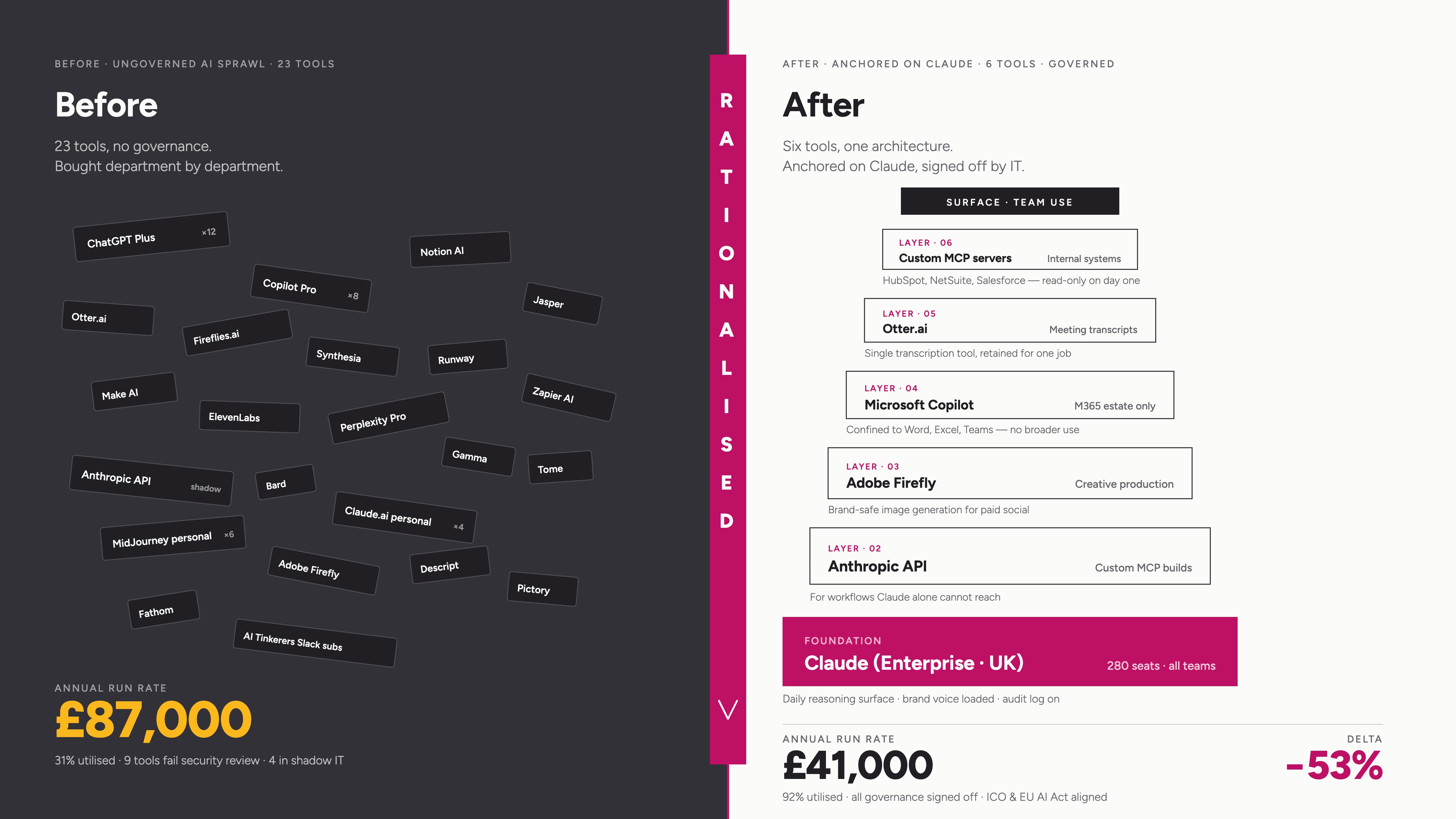
Most growing businesses now spend on AI tools without a coherent picture of what they have. ChatGPT licences here, Copilot subscriptions there, half integrated Notion AI bolt ons, three different transcription services, a Zapier setup somebody built in a hackathon. Tool sprawl that drains budget, fragments practice and stops the team trusting any of it.

We audit your stack, score every tool against the work it should be doing, recommend what to keep, what to retire and what to consolidate. The rationalised stack is usually leaner, cheaper and faster. Sharpest thinking, not biggest budgets, applied to your AI spend.

What you get:

  • A documented inventory of every AI tool in your business and the use case it serves
  • A scoring framework that maps each tool to commercial value, adoption, security posture and total cost
  • A prioritised list of what to keep, retire, consolidate or replace
  • A consolidation plan that anchors the stack around Claude and the right supporting tools
  • A governance posture for the rationalised stack, mapped to EU AI Act and ICO obligations

Why AI tool sprawl happens

Every team buys what solves its own problem. Marketing buys ChatGPT licences. Sales buys an AI note taker. Operations buys an automation platform. Finance buys a forecasting bolt on. IT discovers six months later that none of it is properly governed and most of it overlaps. The total spend lifts. The combined value falls.

What a rationalised stack looks like

One anchor model with clear capability. A small set of supporting tools each doing one thing well. Clear lines between what runs centrally and what runs in functions. Properly governed, properly licensed, properly understood. Lower total cost, higher total return.

What we audit

Every AI subscription, every Copilot licence, every automation tool, every transcription service, every model API, every bolt on inside SaaS platforms you already pay for. Usage data where available. Adoption patterns. Security posture. Licensing terms. Total cost. Real value produced.

Why Claude as the usual anchor

For most UK businesses Claude is the right anchor model. It runs on AWS Bedrock UK South for data residency. It handles the reasoning, writing and analysis work most teams want from AI. Anthropic's Constitutional AI approach satisfies regulated and enterprise buyers. We anchor the stack around it for most clients, and where another model is the better fit, we say so.

Where ChatGPT and Copilot still earn their place

The audit is honest about where alternatives earn their keep. Microsoft Copilot can stay for businesses deeply in the Microsoft 365 estate. ChatGPT Enterprise can stay where the team has built skills around it. The point is intentionality, not religion. The right tool for the right job, properly governed.

Where to retire spend

Most stacks have at least three tools doing what one would do better. The audit identifies the duplications, the abandoned subscriptions, the bolt ons paid for but never used and the cheaper consolidations available. Retired spend funds the work that actually compounds value.

Where to consolidate around the operating model

Some tools sit in the wrong place. A marketing tool used by sales should usually move. A finance tool used by operations should usually move. The audit aligns ownership with use, simplifying procurement and governance.

Where to bring in the right partner

Sometimes the right answer is a new tool brought in correctly. The audit identifies those moments, recommends the right partner and tells you how to integrate it without adding to the sprawl.

For CFOs and procurement leaders

You see the total AI spend in one place for the first time. You see the duplications, the unused licences and the consolidation opportunities. The audit usually pays back in retired spend before any rationalisation work begins.

For CIOs and IT leaders

You see the governance posture across every tool, the security gaps, the data residency positions and the consolidation that will simplify the estate. Shadow IT becomes visible IT. Risk reduces.

For marketing and operations leaders

You see which tools your team actually uses, which tools they should be using and where adoption has broken down. The rationalised stack accelerates the work rather than getting in its way.

For the board

You get a defendable view of AI spend, a credible consolidation plan and a clear picture of the operating model the rationalised stack supports. The conversation moves from sprawl to strategy.

What the audit usually finds

Between 20% and 40% of AI tool spend going on duplications, unused licences and overlapping capability. A clear anchor model opportunity that simplifies the rest of the stack. Two or three tools quietly producing most of the real value. A governance gap that needs closing before the next compliance review.

What we hand over

A tool inventory, a scoring framework, a prioritised rationalisation list, a consolidation plan and a governance posture. You can run the rationalisation yourself, run it with your IT team or bring us back for the consolidation work.

For the existing Microsoft estate

If your business runs on Microsoft 365, the audit gives you a clear view of where Copilot fits, where Claude adds capability Copilot cannot, and how to integrate both without doubling spend.

For the existing Google Workspace estate

If your business runs on Google Workspace, the audit covers Gemini, the third party AI assistants integrated into Workspace and the points where Claude consolidates capability.

Compliance and data residency

Every tool in the audit is mapped to its data residency, retention, model training and personal data position. Tools that fail the governance bar are flagged. The rationalised stack has a documented EU AI Act and ICO position.

Independent and honest

Teylu does not take rebates from tooling vendors. The recommendation is scored on commercial fit, not on partner economics. If the right answer is a tool we have no relationship with, we will say so. Partnership, not transaction.

Why Teylu, not a procurement consultancy

Procurement consultancies focus on price. We focus on the operating model the tools support. The savings the audit produces are a useful side effect, but the real value is a stack that compounds the team's work rather than fragmenting it.

Why Teylu, not an internal IT exercise

Internal IT teams often lack the marketing, sales and operations context to score AI tools by real commercial value. Senior Teylu people bring that context and the independent view that internal political dynamics make hard to deliver.

Typical timeline

Two to three weeks from kick off to delivered audit. Week one is inventory and usage data collection. Week two is scoring, prioritisation and consolidation design. Week three is governance posture, written output and leadership presentation.

Engagement model

Fixed scope audit, then optional consolidation engagement to deliver the rationalisation. Most clients move into a brief consolidation engagement off the back of the audit to retire spend and tighten governance quickly.

See the audit in action

See how Teylu has rationalised AI stacks for marketing teams, operations teams and finance teams across the UK, with the consolidation outcomes that followed.

Brief Us
Brief Us

This is built for businesses that recognise their AI spend has run ahead of their AI strategy. That usually means:

Scaling businesses where AI subscriptions have multiplied across functions without a coherent operating model.

CFOs and procurement leaders who cannot get a clean view of total AI spend across the business.

CIOs and IT leaders trying to bring shadow AI into a properly governed estate.

Marketing, sales and operations leaders wanting their team's AI work to compound rather than fragment.

Step 1: Inventory and usage capture

Week 1

We document every AI tool the business uses, every licence held, every integration in place and every usage signal available. Shadow IT included.

Outcome

A documented inventory of your AI stack as it actually exists today. Often the first time the business has had a single view across the estate.

Step 2: Scoring and consolidation design

Week 2

We score every tool against commercial value, adoption, governance posture and total cost. We design the consolidation map.

Outcome

A clear keep, retire, consolidate or replace decision for every tool. The consolidation map shows what the rationalised stack looks like, anchored around Claude where it fits.

Step 3: Governance and written output

Week 3

We document the EU AI Act and ICO position of the rationalised stack, build the change communication plan and deliver the written audit to leadership.

Outcome

A documented audit, a defensible rationalisation plan and a clear path to act. Many clients begin the consolidation inside the same month.

Step 4: Optional consolidation engagement

Following weeks

Where you want us back, we run the consolidation. Retire the right spend, configure the anchor stack, retrain the team, tighten the governance.

Outcome

A rationalised stack live in production. Retired spend in the budget. Team trained on the anchor tools. Governance signed off.

Book a discovery call

Tell us what your stack looks like today and where the friction sits. We will tell you whether the audit is the right next move.

Brief Us
Brief Us

Two tiers, sized to the breadth of your existing stack.

Stack Audit (entry tier)
A two to three week audit covering inventory, scoring, consolidation design, governance and the written output. Senior Teylu people on the engagement throughout.

Audit Plus Consolidation (combined)
The audit followed by the consolidation engagement to retire spend, configure the anchor stack and embed the rationalised model with the team.

Pricing is transparent and sized to the breadth of the existing estate. Enterprise grade thinking without the enterprise overhead.

Proof over promises

The audit framework is built on the operating depth Teylu has applied across client AI implementations that produced 391% search market share growth and 73% cost per lead reduction for HMS Networks, 411% conversion lift for Blake Mill Menswear and 3,000 sales opportunities in 90 days. The recommendations come from what works in production, not what looks neat in theory.

Talk to the AI Labs team

If your AI stack has run ahead of your operating model and the spend is harder to defend than the value it produces, this is built for you.

Talk to the AI Labs team

Speak to a senior member of the team. We will scope a discovery in the call and give you a clear next step.

Brief Us
Brief Us

What does the audit usually uncover?

Most audits surface between 20% and 40% of AI tool spend going on duplications, unused licences or overlapping capability. A clear anchor model opportunity that simplifies the rest of the stack. Two or three tools quietly producing most of the real value. A governance gap that needs closing.

Will you tell us to scrap Microsoft Copilot or ChatGPT?

Only if the audit says so. The audit is honest. Copilot can stay where it earns its place inside Microsoft 365. ChatGPT Enterprise can stay where the team has built skills around it. The right tool for the right job, properly governed.

Is this audit independent?

Yes. Teylu does not take rebates from tooling vendors. The recommendations are scored on commercial fit, not partner economics. If the right answer is a competitor tool or no tool, we will say so. Partnership, not transaction.

How long does the audit take?

Two to three weeks. Week one is inventory and usage capture. Week two is scoring and consolidation design. Week three is governance posture, written output and leadership presentation.

Do you also run the consolidation?

Optionally. Most clients move into a brief consolidation engagement off the back of the audit to retire spend and tighten governance quickly. Some run the rationalisation themselves once the audit is delivered. Either way, the audit pays back in retired spend.

Speak to the team

Have a question we have not answered? Tell us. We will give you a straight answer, not a pitch.

Brief Us
Brief Us

Reach out and let’s do something remarkable together.

Contact Us
Contact Us