B2B Demand Generation

Your pipeline should not go quiet the month you stop spending. We build the engine that keeps it full.

You need qualified pipeline from buyers who take a year to decide, not a spike of cheap leads. We build and run the demand engine that keeps producing, month after month.

B2B Demand Generation — hero

Results our clients report to their boards

35:1

Your media return, if your campaign runs like HMS Networks' first one did

£760 to £72

What HMS now pays for a confirmed sales ready lead, down from a typical trade event lead

1,588

Sales ready leads HMS generated on reporting they own and operate

42x

Media efficiency Arrow ECS achieved against benchmark with VMware

Why demand generation matters in industrial and technology B2B

In these markets the buyer rarely fills in a form on day one. Six to ten people influence the decision, they research quietly for months, and the brand they already recognise wins the shortlist. Demand generation is how you become that recognised, trusted name before the buyer is ready to talk. Done badly it produces clicks and noise. Done properly it produces qualified conversations your sales team is glad to have. We build for the second outcome.

What changes when the engine is running

Pipeline stops depending on the last event or the latest list someone bought. You get a predictable flow of qualified opportunities, a clear view of which channels and messages produce them, and the ability to turn investment up or down with confidence. Sales and marketing stop arguing about lead quality because the definition was agreed and the data is shared.

What changes for you

What we provide:

  • A demand engine that runs across paid, organic, email and account-based channels rather than one isolated tactic
  • Target account and audience definitions tied to real revenue potential, not vanity reach
  • Campaign builds, creative and landing experiences shipped to deadline
  • Lead handover that sales actually trusts, with scoring and routing agreed up front
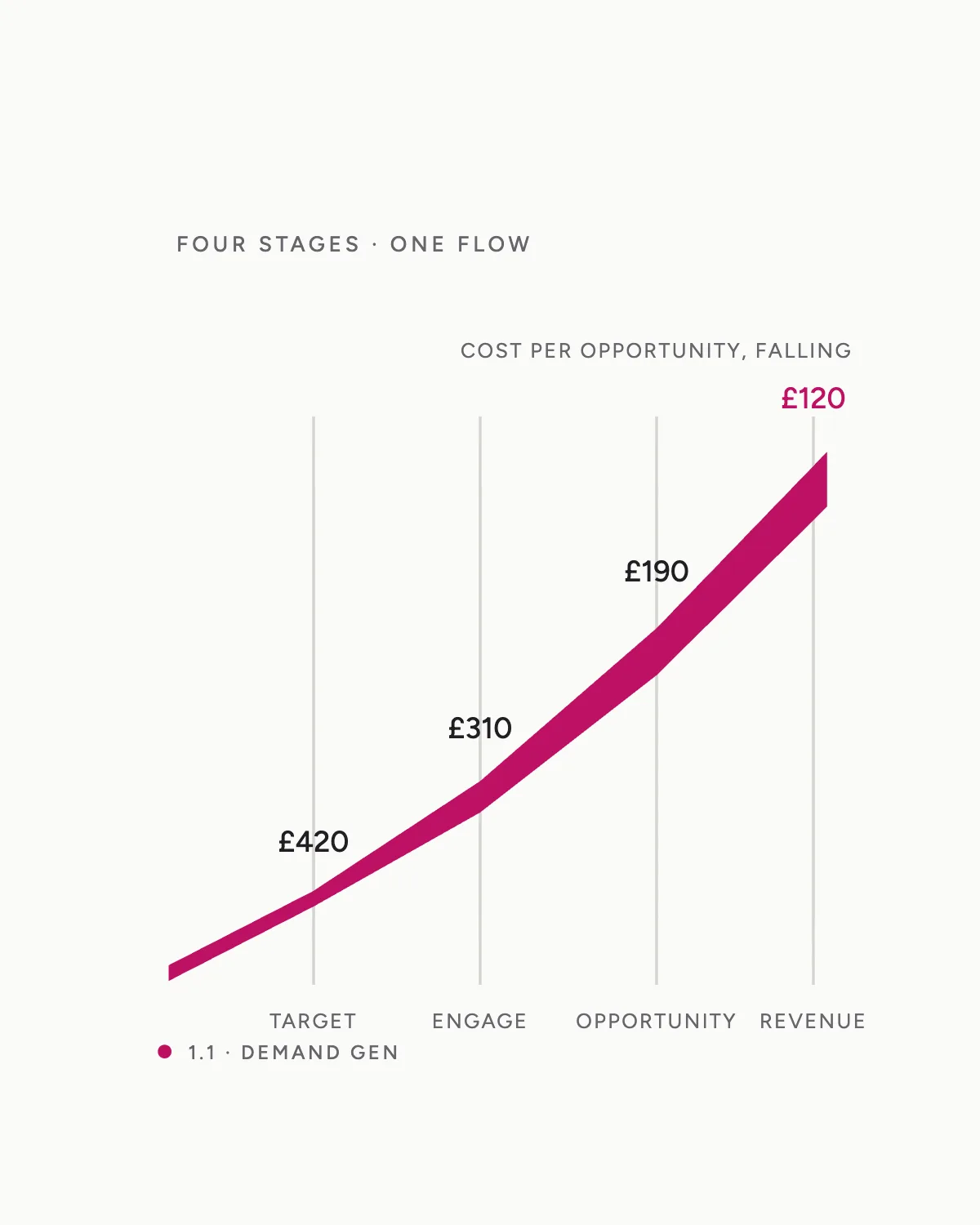
  • Weekly reporting on pipeline contribution, cost per opportunity and conversion at each stage

Demand generation is the part of marketing where plans meet pipeline. This is the delivery pillar: the team that runs the campaigns, builds the lists, ships the content and reports the numbers your sales floor can act on. We work with industrial and technology B2B organisations where the buying group is large, the sales cycle is long and a single closed deal is worth pursuing properly.

The proof sits in the work. For HMS Networks we delivered a 35:1 media return and cut the cost of a sales ready lead from around £760 to £72. You can read how that was built on our HMS Networks case study. That is the standard we hold ourselves to across every demand programme we run.

Talk to us about the pipeline you need next quarter and we will show you how the engine would be built.

Book a demand generation review

Not suitable for all businesses

This fits if you are

This pillar suits organisations that need predictable pipeline from a technical, considered-purchase audience and want a team that runs the engine rather than just advising on it.

Industrial and manufacturing businesses selling complex products into long buying cycles, where credibility with engineers and specifiers decides the shortlist.

Electronics and technology firms that need to reach specialist buyers at scale without diluting the technical accuracy of the message.

Distribution and channel organisations whose growth depends on partners and resellers as much as end customers.

IT and software providers selling into committees, where several stakeholders must each be reached with the right argument.

Not the right engagement if

  • You want a burst of leads for one quarter, not a pipeline that keeps producing.
  • There is no sales follow up in place to work the pipeline we create.
  • You are not ready to be measured on pipeline and revenue rather than clicks.

How we deliver this

1

Step 1: Diagnostic and definition

Weeks 1 to 2

We audit current demand activity, agree target audiences and accounts, and define what a qualified opportunity actually is with your sales team. Nothing gets built until the target and the bar are clear.

Outcome

A shared definition of success, an agreed target audience and a prioritised channel plan everyone has signed off.

2

Step 2: Build the core

Weeks 3 to 6

We build the campaigns, creative, landing experiences and the data and automation plumbing underneath. Lead routing and scoring are wired into your CRM before anything goes live.

Outcome

A working demand engine, live across the first set of channels, with clean handover into sales from day one.

3

Step 3: Run and optimise

Weeks 7 onward

We operate the engine, report weekly, and shift budget toward what produces. Underperforming channels are cut, winning ones are scaled, and new tests are run continuously.

Outcome

A steady flow of qualified opportunities with falling cost per opportunity as the engine learns.

4

Step 4: Embed and hand over

Ongoing

We document the system, train your team and make sure the engine runs whether or not we are in the room. Ownership transfers to you by design, not as an afterthought.

Outcome

An owned, documented demand engine your team can operate and a partner on call when you want to push it further.

Proof over promises

The question is who builds it, and who owns it afterwards

Why Teylu over a generic agency

A generalist agency will run your ads and send a dashboard. We understand the industrial and technology buying group, write credibly for technical audiences, and tie everything back to pipeline. The HMS result, a 35:1 media return and a cost per sales ready lead cut from around £760 to £72, came from that specialism, not from a bigger media budget.

Against an enterprise agency

Quarters, not weeks

Six month discovery phases and a quarter million before a single dashboard exists. We work in weeks, with senior people on every call and pricing itemised line by line.

Proven in the channel

We also run demand programmes for distribution and channel businesses such as Arrow ECS, where the audience is partners and resellers rather than direct end customers. The mechanics of reaching a technical channel are different, and we build for that difference.

Start small, own everything

We run demand generation in three stages. The Diagnostic entry is a short, fixed-scope piece that audits your current activity and produces the plan and the qualification model. From there the Build core stage stands up the campaigns, data and automation, billed against a defined scope. Then the Embedded ongoing stage runs and optimises the engine on a monthly retainer sized to your channel mix.

Pricing is built line by line and shared in full, so your finance team can see exactly what each element costs and why. There are no opaque contingency blocks and no surprise platform fees, because the systems run on infrastructure you own. Enterprise grade thinking without the enterprise overhead.

Client testimonials

Star iconStar iconStar iconStar iconStar icon

"Complete dedication to our brand mission by Teylu. They worked within our limitations and made our marketing profitable on first purchase."

Ken Price

Ken Price

CEO, Blake Mill Menswear

Star iconStar iconStar iconStar iconStar icon

"Teylu delivered rapid activation, delivered immediate sales uplift. Assisted in delivering a business exit and increased valuation."

Katie Dixon

Katie Dixon

Founder, Evellier Luxury Intimates

Star iconStar iconStar iconStar iconStar icon

"It's a pleasure to work with the whole Teylu team. They delivered our exact brief quickly to great effect. What more can you ask for?"

Sophie Fresson

Sophie Fresson

Head of Digital, Oceana UK

B2B demand generation questions, answered

How is this different from your demand generation strategy service?

Strategy decides where to play, how to position and what to invest in. This pillar is the delivery arm that builds and runs the campaigns, the data plumbing and the reporting. Many clients buy the strategy first and then this pillar to execute it, but you can engage either on its own.

How long before we see pipeline?

A first campaign is usually live within four to six weeks. Early cost-per-lead signal appears inside the first month, and meaningful pipeline contribution typically shows from the second quarter as the engine compounds. We set this expectation clearly at the start rather than promising overnight results.

Do we own the system or rent it from you?

You own it. Every campaign, audience, automation and dashboard we build sits on infrastructure you already own and operate. There is no enterprise platform licence to keep paying, and if our engagement ends the engine keeps running and the knowledge stays with your team. You are investing in infrastructure you keep, not renting access you lose.

Will the leads be good enough for our sales team?

We agree the qualification bar with your sales leaders before anything goes live, route opportunities cleanly into your CRM, and feed back what closes so the engine sharpens each quarter. That is how the HMS Networks programme generated 1,588 sales ready leads that the sales team actually pursued.

Do you work in our industry?

Our work concentrates in industrial automation, electronics, manufacturing, distribution and IT. These are technical, considered-purchase markets, and we write credibly for engineers, specifiers and channel partners rather than relying on generic marketing language.

Book a discovery call

Still have questions? Talk to the team that would run your demand engine.

Brief Us
Brief Us

Book your Data and Demand Diagnostic

Tell us where the data lives and what the board keeps asking. A senior person reads every one of these.

Thank you! Your submission has been received!
Oops! Something went wrong while submitting the form.

What happens next

1. A senior person replies within one working day. Not a sales development rep, not an automated sequence.

2. Thirty minutes to scope whether this is the right move. If it is not, we say so and point you somewhere better.

3. You get a written scope, priced line by line. No pitch decks unless you ask for them.