
AI Integration with CRM, ERP and Ecommerce Platforms

The biggest unlock for most businesses is not a new AI tool. It is Claude working directly inside the systems they already use. The CRM that holds the sales conversations. The ERP that holds the operating data. The ecommerce platform that holds the customer behaviour. The bespoke system that holds the institutional knowledge.

Teylu builds the integrations that put Claude inside those systems, where the work actually happens. The result is AI that does work in the systems your team already opens every morning, not a separate chat window competing for attention.

What you get:

  • Claude integrated directly into your CRM, ERP, ecommerce platform and bespoke systems
  • Custom MCP servers built where standard integrations do not exist, giving Claude controlled access to your data
  • In-context AI capability inside the tools your team already uses, not in a separate window
  • Permission inheritance from your existing systems, so sensitive data stays sensitive
  • Documented governance, audit trail and compliance posture for procurement and security review

Why standalone AI fails to compound

A standalone AI tool sits in a separate tab. The team has to remember to use it. Context has to be copied in. Output has to be copied out. The friction breaks adoption and the value caps below where it should sit. The fix is integration: put Claude where the work already happens.

What integrated AI looks like

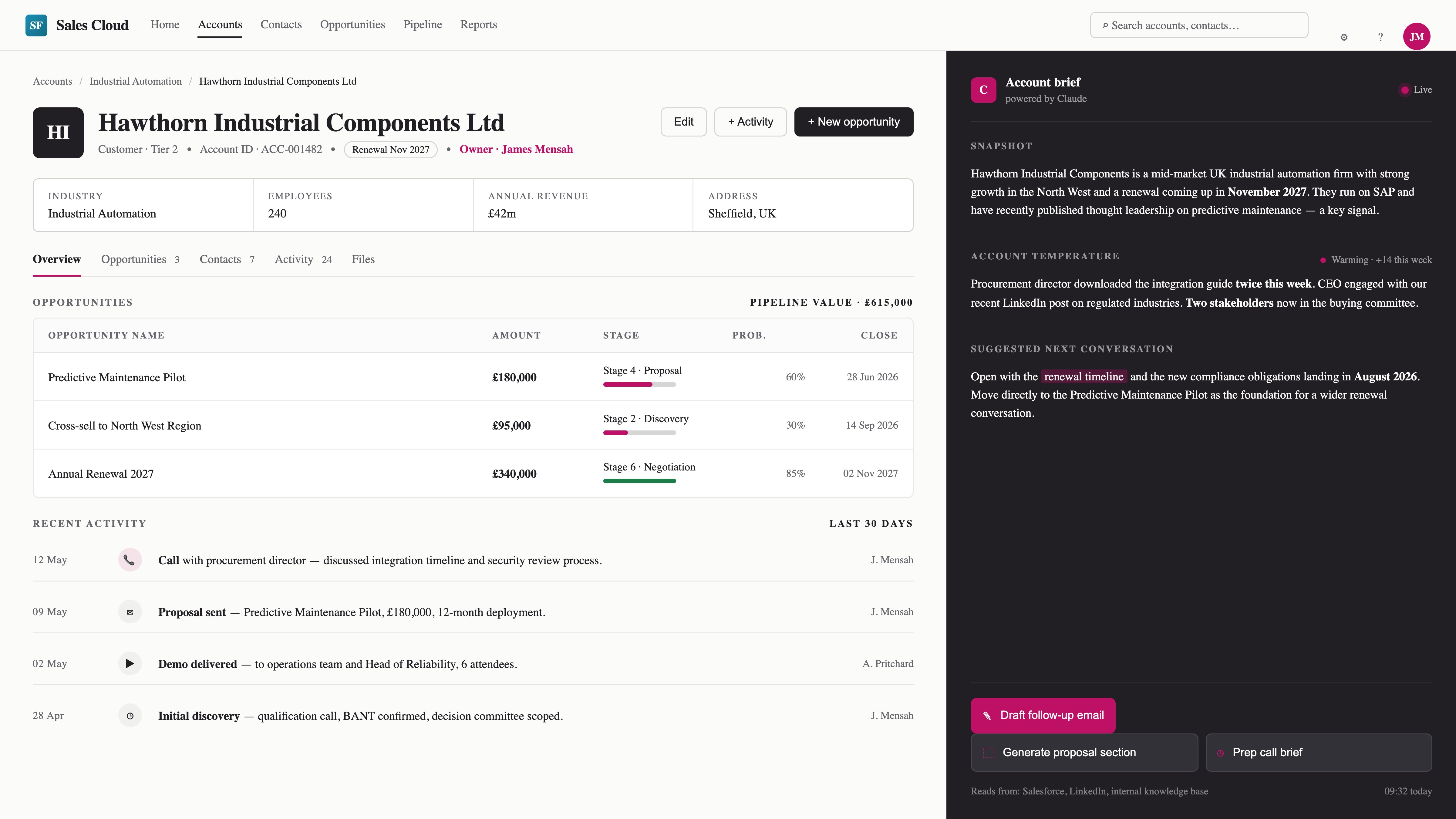
The sales rep opens the account in Salesforce and sees a Claude generated account brief. The finance lead opens the invoice in NetSuite and sees Claude's exception commentary. The customer success manager opens the ticket in HubSpot and sees Claude's draft response. The work happens in the tool. The team adopts naturally.

What we integrate with

CRMs: Salesforce, HubSpot, Microsoft Dynamics, Pipedrive, Pardot, Marketo. ERPs: NetSuite, SAP, Sage, Microsoft Dynamics 365 Business Central, Xero. Ecommerce: Shopify Plus, BigCommerce, Magento, WooCommerce, custom platforms. Service: Zendesk, Intercom, Freshdesk. Anywhere your team works, Claude can work alongside.

Why MCP changes the integration story

Until recently, integrating an AI model with business systems meant brittle custom code per integration. The Model Context Protocol changes that. We build custom MCP servers where they do not exist and use standard ones where they do. The result is a maintainable, governable integration layer that compounds across use cases.

Salesforce and HubSpot

Claude as an assistant inside the CRM. Account briefs on demand. Lead scoring with explanation. Email drafting with brand voice. Call summarisation. Pipeline commentary. The sales team opens the CRM as usual and finds Claude already working alongside them.

NetSuite, SAP and finance systems

Claude as a finance assistant inside the ERP. Variance commentary, exception flags, board paper draft sections, contract summary, supplier monitoring. Finance closes faster, with sharper commentary, and the human time goes to judgement calls rather than report assembly.

Shopify Plus and ecommerce platforms

Claude as a merchandising and customer experience assistant. Product description generation, on brand variant copy, customer journey explanation, basket abandonment analysis, lifecycle programme commentary. Merchandising teams ship faster and customer experience teams act earlier.

Bespoke systems

Where your business runs on a custom system, we build the custom MCP server. Claude gains controlled, audited, permission aware access. The benefit is the same as the SaaS integrations: AI working where the team already works, with the data they already trust.

Built on Anthropic's stack

The integrations are built on Claude through AWS Bedrock UK South, with MCP as the protocol layer and the Claude Agent SDK where agent style behaviour is needed. The result is a coherent, supportable integration architecture rather than a wild assortment of bespoke code.

Permission inheritance from your systems

Claude does not see anything your team is not authorised to see. Permissions inherit from your CRM, ERP or ecommerce platform automatically. Sensitive accounts stay restricted. Personal data flows are minimised. The integration respects the access model you already operate.

For sales operations leaders

You get a CRM that does more of the work itself. Lead enrichment, account briefing, follow up drafting, call summarisation, opportunity coaching. The CRM stops being a data entry chore and starts being a working assistant.

For finance and operations leaders

You get an ERP that drafts the commentary, flags the exceptions and summarises the reports. Month end accelerates. Audit conversations get shorter. Finance team time shifts from assembly to insight.

For ecommerce and merchandising leaders

You get a Shopify Plus or BigCommerce instance that generates on brand product copy, explains performance and surfaces merchandising opportunities. Time from product launch to live, optimised listing collapses dramatically.

For technology and security leaders

You get a properly architected, documented integration layer with governance baked in. No shadow integrations. No undocumented data flows. The integration architecture is reviewed against your security model before it goes live.

For traditional UK businesses

If your CRM, ERP and operating systems were built for stability rather than AI integration, this is the way in. We build the MCP servers and the integration patterns that bring Claude into systems that were never designed with AI in mind.

For scaling businesses

If your team has outgrown the founder led integrations and the Zapier scaffolding is starting to creak, this is the next move. A proper integration architecture replaces the patchwork, with governance and maintainability designed in.

Compliant by design

Every integration runs on Claude through AWS Bedrock UK South for UK data residency. Personal data is masked, audit trails are clean and the deployment is mapped against EU AI Act categorisation and ICO AI Code of Practice. Your governance teams get the documentation they need.

Maintainable integration architecture

We do not write bespoke spaghetti. The integration is built on MCP, documented for handover and designed to be maintained either by your team or by Teylu on a retainer. Either way the architecture compounds rather than depreciating.

Why Teylu, not a CRM consultancy

CRM consultancies install CRMs. We integrate AI into them. We bring marketing, sales and operating model depth to the integration so the AI inside the CRM serves the actual work of the team, not just the dashboard view.

Why Teylu, not a generic integration partner

Generic integrators connect systems. We integrate AI into systems with the safety, governance and operating model considerations that make it usable in production. The difference shows up when the integration has to survive a security review or an audit.

Typical timeline

Four to ten weeks from discovery to live integrations, depending on the number of systems and the complexity of the MCP servers required. Phase one scopes the integrations and designs the architecture. Phase two builds the MCP servers and the in context AI experiences. Phase three deploys, tunes and embeds with the team.

Engagement model

Fixed scope integration build, then ongoing retainer for maintenance, capability extension and integration of new systems as they come into the stack.

See integrations shipped

See the AI integrations Teylu has shipped into CRMs, ERPs and ecommerce platforms for clients across the UK.

Brief Us
Brief Us

This is built for businesses that already run on serious operating systems and want to bring AI into them properly. That usually means:

Sales operations and RevOps leaders with a Salesforce or HubSpot estate that should be doing more work itself.

Finance and operations leaders with NetSuite, SAP or Sage and a finance team spending too much time on assembly.

Ecommerce and merchandising leaders on Shopify Plus or BigCommerce with growing product volume and shrinking creative capacity.

Technology and security leaders wanting a governed, documented AI integration layer rather than shadow integrations across the estate.

Step 1: Discovery and integration design

Week 1 to 2

We document the systems, the work that benefits from in context AI and the permission models that need to inherit. We design the integration architecture and the MCP server scope.

Outcome

A documented integration specification with architecture, MCP scope and governance model. Sign off before any code is written.

Step 2: Build and integrate

Week 2 to 7

We build the MCP servers, configure the in context AI experiences, integrate with your systems and run tests against real work in a staging environment.

Outcome

Working integrations in staging. Tested against real data. Audit trail clean. Permission inheritance verified.

Step 3: Deploy and embed

Week 7 to 9

We deploy into production, deliver the governance documentation, train the team on the in context experiences and embed the new working pattern with each function.

Outcome

Live integrations in active use. A team adopting AI naturally because the AI shows up where they already work. Governance documentation signed off.

Step 4: Extend and evolve

Week 9 onwards

We extend the integration coverage as new use cases surface, add new systems as they enter your stack and bring new MCP and SDK capabilities in as Anthropic ships them.

Outcome

An AI integration layer that compounds in value as it covers more of the operating model. A team that increasingly expects AI to be present in every tool.

Book a discovery call

Tell us which systems you run and where the AI integration would deliver value. We will tell you whether this is the right next move.

Brief Us
Brief Us

Three tiers, sized to the breadth of the integration.

Integration Scoping (entry tier)
A two week scoping engagement covering integration architecture, MCP scope and governance design, with a written specification and build estimate.

Implementation (core tier)
Four to ten week build of the integrations, the MCP servers, the in context experiences and the governance documentation. Senior Teylu engineers embedded throughout.

Embedded AI Labs (ongoing tier)
Monthly retainer to maintain, extend and evolve the integration layer.

Pricing is transparent, sized to the system count and the integration depth.

Proof over promises

Our team has shipped integrations across Salesforce, HubSpot, NetSuite, Shopify Plus and bespoke systems for clients including HMS Networks, Arrow ECS, Timberplay, TouchWood Play and Blake Mill Menswear. The integration patterns and MCP servers are production tested, not prototype work.

Talk to the AI Labs team

If your team is using AI in a separate tab when it should be inside the CRM, ERP or ecommerce platform they already work in, this is built for you.

Talk to the AI Labs team

Speak to a senior member of the team. We will scope a discovery in the call and give you a clear next step.

Brief Us
Brief Us

Will our team have to leave the CRM or ERP to use this?

No. Claude shows up inside the tools your team already uses. Sales sees account briefs inside Salesforce. Finance sees commentary inside NetSuite. Customer success sees response drafts inside HubSpot. The work happens where the team already works.

What if our system does not have a standard MCP server?

We build a custom one. The custom MCP server gives Claude controlled, audited, permission aware access to the system. Bespoke systems, internal databases and SaaS without standard integrations are all in scope.

Does Claude see all our data?

Only what your team is authorised to see. Permissions inherit from your CRM, ERP or ecommerce platform automatically. Sensitive content stays restricted. Personal data flows are minimised. The integration respects the access model you already operate.

What about security and audit?

The integration is built on Claude through AWS Bedrock UK South for UK data residency. Every action is logged. Every tool call is auditable. The architecture is reviewed against your security model before it goes live.

How is the integration maintained over time?

The architecture is built on MCP, documented for handover and designed to be maintained either by your team or by Teylu on a retainer. We do not write bespoke spaghetti. The integration compounds rather than depreciating.

Speak to the team

Have a question we have not answered? Tell us. We will give you a straight answer, not a pitch.

Brief Us
Brief Us

Reach out and let’s do something remarkable together.

Contact Us
Contact Us