

Marketing Data Integration

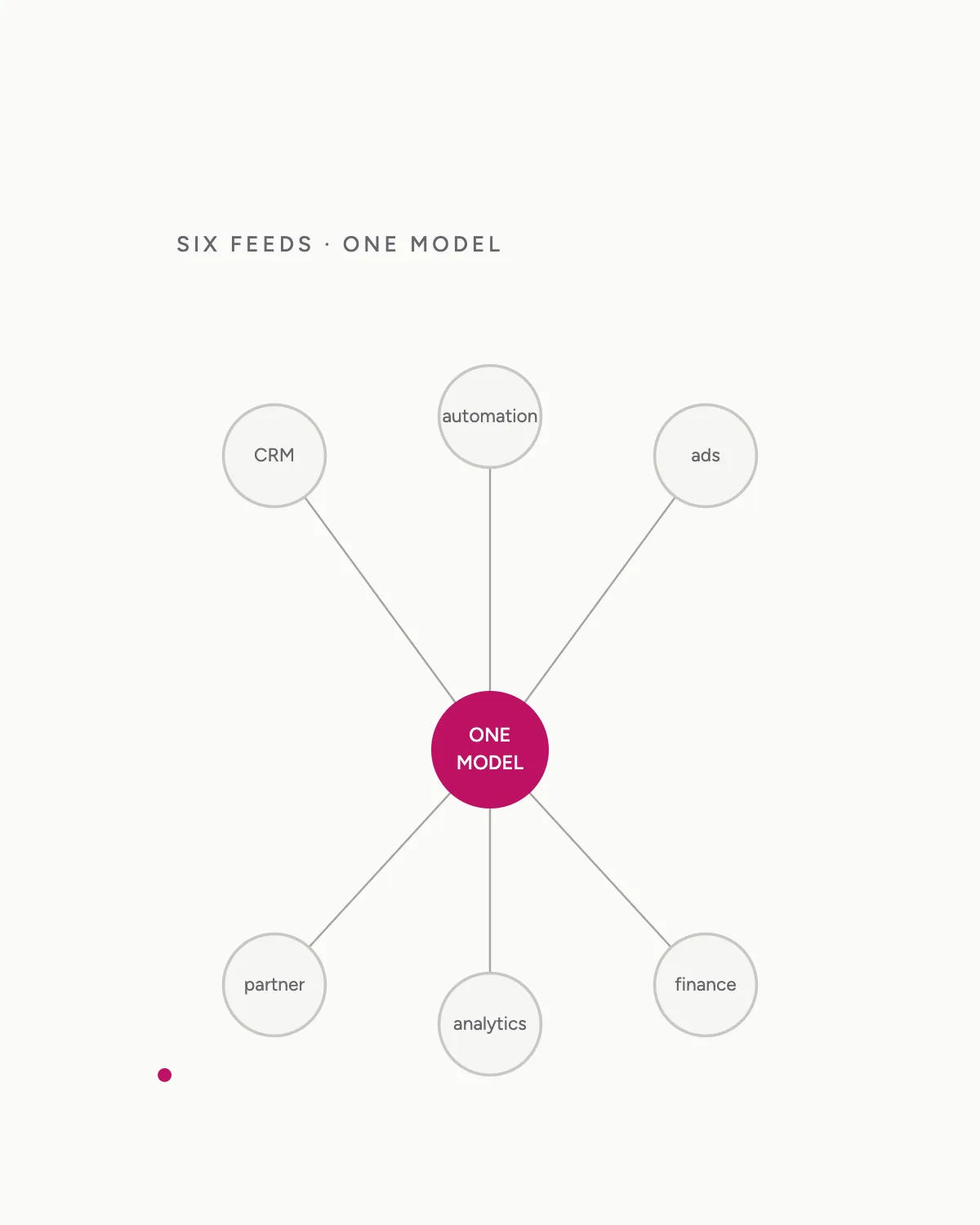
Most B2B marketing data sits in places that do not talk to each other. The CRM holds one version of the truth, the marketing automation platform holds another, ad accounts report in their own currencies, and channel partner feeds arrive as spreadsheets. We build custom integrations that pull all of it into a single data model, so you stop reconciling sources by hand and start working from one number everyone trusts.

This is the work that made the difference for HMS Networks, where unified data underpinned 391% search market share growth and 3,000 sales opportunities in 90 days. We build the same plumbing into systems you already own, not a platform you rent, so the model stays yours long after the build is done.

What you get:

  • A single data model joining CRM, marketing automation, ad accounts, analytics and channel feeds
  • Custom connectors built for your exact stack, not off-the-shelf wrappers
  • Clean, de-duplicated records with one agreed definition of a lead and an opportunity
  • Scheduled refreshes so the model stays current without manual exports
  • Documentation and handover so your team can run and extend it

One model, built into systems you own

We map every source you rely on, agree the definitions that matter, then build the integrations that bring them together. The result is a single model that lives on infrastructure you already pay for. You own the pipelines, the logic and the data. There is no recurring platform licence quietly growing each year.

Why integration comes first

Dashboards, attribution and AI are only as good as the data underneath them. Get the integration right and every layer above it becomes straightforward. Skip it and you spend the next two years arguing about whose number is correct. We treat the data model as the foundation of the whole data unification pillar.

What we build

Connectors for your CRM, marketing automation platform, Google and LinkedIn ad accounts, web analytics and partner data feeds. We handle field mapping, de-duplication, identity resolution across systems, and the scheduled jobs that keep everything in step. Everything is built to run inside infrastructure you control.

Built to be handed over

We do not build a black box only we understand. Every integration is documented, every transformation is explained, and your team gets a working handover. If you want us to keep running it we are happy to, but the choice stays yours because the system is yours.

For the marketing leader

You get one set of numbers you can take into a board meeting without a caveat. No more three versions of pipeline contribution depending on which tool exported them. Decisions get faster because the argument about data stops.

For the data and analytics team

You get clean, modelled inputs instead of raw exports. We do the joining and de-duplication so your team spends its time on analysis, not on stitching CSVs together every Monday morning.

For the RevOps function

Lead and opportunity definitions finally line up across marketing and sales systems. Routing, scoring and reporting all read from the same model, which means fewer disputes at the marketing and sales handover.

For the IT and infrastructure owner

Everything runs on infrastructure you already own and govern. No new enterprise platform to procure, secure and renew. You keep control of where the data sits and who can reach it.

Talk to us about integration

If your reporting depends on someone manually exporting and reconciling data each week, that is a sign the integration layer is missing. We can fix it once, properly, in systems you own.

Brief Us
Brief Us

Works with the rest of the pillar

Integration feeds straight into unified marketing dashboards and conversion and attribution intelligence. Get the model right here and those layers come together quickly.

And feeds the AI layer

A clean, unified model is what makes AI data systems useful rather than noisy. Anomaly detection and insight automation need trustworthy inputs, and that is exactly what integration provides.

For the buyer who owns reporting

If you are the person who gets asked why two reports disagree, this is the work that ends that question. One model, one definition, one answer.

For the buyer who owns budget

Integration removes the manual hours spent reconciling sources and the licence cost of yet another reporting platform. The model you own keeps paying back long after the project closes.

For industrial and manufacturing businesses

Long sales cycles and distributor relationships mean data scatters across CRM, ERP-adjacent systems and partner feeds. We bring it together so you can see the full picture from first touch to closed order.

For electronics and distribution

Channel and distribution models, like the work we do with Arrow ECS, generate partner feeds that rarely match internal records. We resolve identity across them so partner-influenced pipeline is finally visible.

Why Teylu, not a generic agency

Most agencies stop at the dashboard and quietly rely on someone else for the plumbing. We build the integration ourselves, in code, in systems you own. That is the harder, more durable half of the job, and it is the half most agencies avoid.

Why Teylu, not an enterprise platform

An enterprise data platform solves integration by charging you every year to keep your own data flowing. We build it once into infrastructure you already own. You invest in an asset you keep, not a subscription that ratchets upward.

You own the data

The integrations, the logic and the model all sit with you. Own your data and own the systems that move it. There is no enterprise licence treadmill and no lock-in to a vendor who holds your pipelines hostage at renewal.

Compliant by design

We build with UK and EU data residency in mind and keep records where you need them. Because the system lives on your infrastructure, you stay in control of access and retention rather than trusting a third-party platform.

For IT and security stakeholders

You review the architecture, you approve where data sits, and you keep the keys. We work to your standards rather than asking you to adopt ours.

Typical timeline

A focused integration is usually live within six to ten weeks, depending on the number of sources and the state of the underlying data. We sequence the work so you see a usable model early rather than waiting for everything at once.

For multi market teams

If you run marketing across the UK, US and Europe, integration is where consistency starts. One model, one set of definitions, applied across markets so regional numbers actually add up to a group view.

For channel and distribution businesses

Partner feeds, distributor portals and internal CRM rarely agree out of the box. We resolve identity across them so you can see true channel contribution, not a partial internal view.

Book a discovery call

HMS Networks shows what a properly integrated model makes possible: 391% search market share growth and 3,000 sales opportunities in 90 days, all reading from data that finally agreed with itself.

Brief Us
Brief Us

Integration matters most when your data is real, plentiful and scattered. These are the teams that get the most from it.

Industrial and manufacturing marketers with long cycles and distributor relationships that split data across many systems.

Electronics and technology distributors who need partner feeds and internal records to finally reconcile.

RevOps and analytics leads tired of stitching exports together and defending mismatched numbers.

Marketing directors who want one trustworthy model before investing in dashboards, attribution or AI.

Step 1

Weeks 1 to 2

Source audit and definition workshop. We map every system, agree what a lead and an opportunity actually mean, and document the model before writing any code.

Outcome

A clear data map and agreed definitions everyone has signed off, so the build has no surprises.

Step 2

Weeks 3 to 6

Connector build. We construct the integrations, handle field mapping and de-duplication, and resolve identity across systems.

Outcome

Live pipelines bringing your sources into a single model on infrastructure you own.

Step 3

Weeks 6 to 8

Validation. We test the model against known numbers, fix discrepancies and confirm refresh schedules hold up.

Outcome

A model you trust, with numbers that match reality and refresh reliably.

Step 4

Weeks 8 to 10

Handover and embed. We document everything and train your team to run and extend the integrations.

Outcome

Full ownership in your hands, with the option to keep us on for support if you want it.

Book a discovery call

Bring us your list of systems and your reporting headaches. We will tell you honestly what a unified model would take.

Brief Us
Brief Us

We run integration work in three stages. Diagnostic: we audit your sources and agree definitions. Build: we construct and validate the integrations in infrastructure you own. Embedded: we hand over, document and offer ongoing support only if you want it.

Pricing is itemised line by line so your finance team can see exactly what each part costs. There is no opaque contingency block and no recurring platform fee hidden in the total. You pay to build an asset you keep. Enterprise grade thinking without the enterprise overhead.

Proof over promises

We would rather point at results than make claims. HMS Networks delivered 391% search market share growth and 3,000 sales opportunities in 90 days on the back of data that finally agreed with itself.

Talk to the team

If you are weighing up whether to integrate now or limp on with manual exports, a short call will tell you which is the cheaper path. Usually it is the model you own.

Start the conversation

Tell us what your stack looks like and where reporting breaks down. We will come back with a clear, costed route to one model you own.

Brief Us
Brief Us

Marketing data integration questions, answered

Do we own the data system or rent it from you?

You own it outright. The integrations, the data model and the logic all sit on infrastructure you already own and operate. There is no enterprise platform licence to keep paying year after year. When the build is done, the asset is yours to run and extend. You are investing in infrastructure you keep, not renting access you could lose at renewal.

How is this different from buying an enterprise data platform?

An enterprise platform charges you every year to keep your own data flowing through it. We build the integration once, into systems you already own, so the running cost is your infrastructure rather than a subscription that climbs each renewal. The thinking is enterprise grade; the overhead is not.

How long does an integration take to build?

A focused integration is usually live within six to ten weeks. The exact timing depends on how many sources you have and how clean the underlying data is. We sequence the work so you see a usable model early rather than waiting for everything to land at once.

What systems can you connect?

CRM, marketing automation platforms, Google and LinkedIn ad accounts, web analytics and channel partner feeds are the common ones. We build custom connectors for your exact stack rather than relying on off-the-shelf wrappers, so even awkward internal or distributor systems can be brought into the model.

Will our team be able to run it after handover?

Yes. Every integration is documented and every transformation explained, and we train your team during handover. If you would rather we kept running it we are glad to, but because the system is yours the choice stays with you, not with a vendor holding the keys.

Book a discovery call

Still weighing it up? Talk to the team that would build your integration.

Brief Us
Brief Us

Reach out and let’s do something remarkable together.

Contact Us
Contact Us