

Martech Stack Strategy and Selection

Buying the next tool is easy. Deciding whether you should is harder, and far more valuable. Martech stack strategy and selection is the work of mapping what you have, designing what you actually need, and choosing tools on merit rather than on a vendor demo. We favour owned, efficient platforms over sprawling enterprise suites, because the suite usually sells you ten things to use two and bills you for all ten every year.

This is the architecture layer of the wider marketing technology pillar. We did this thinking for HMS Networks before the activation that helped deliver 391% search market share growth and 3,000 sales opportunities in 90 days. Get the architecture right and everything downstream costs less and works better. Get it wrong and you pay for the mistake every renewal.

What you get:

  • A full audit of your current tools, contracts, overlaps and renewal dates
  • A target stack architecture mapped to your process, not a vendor checklist
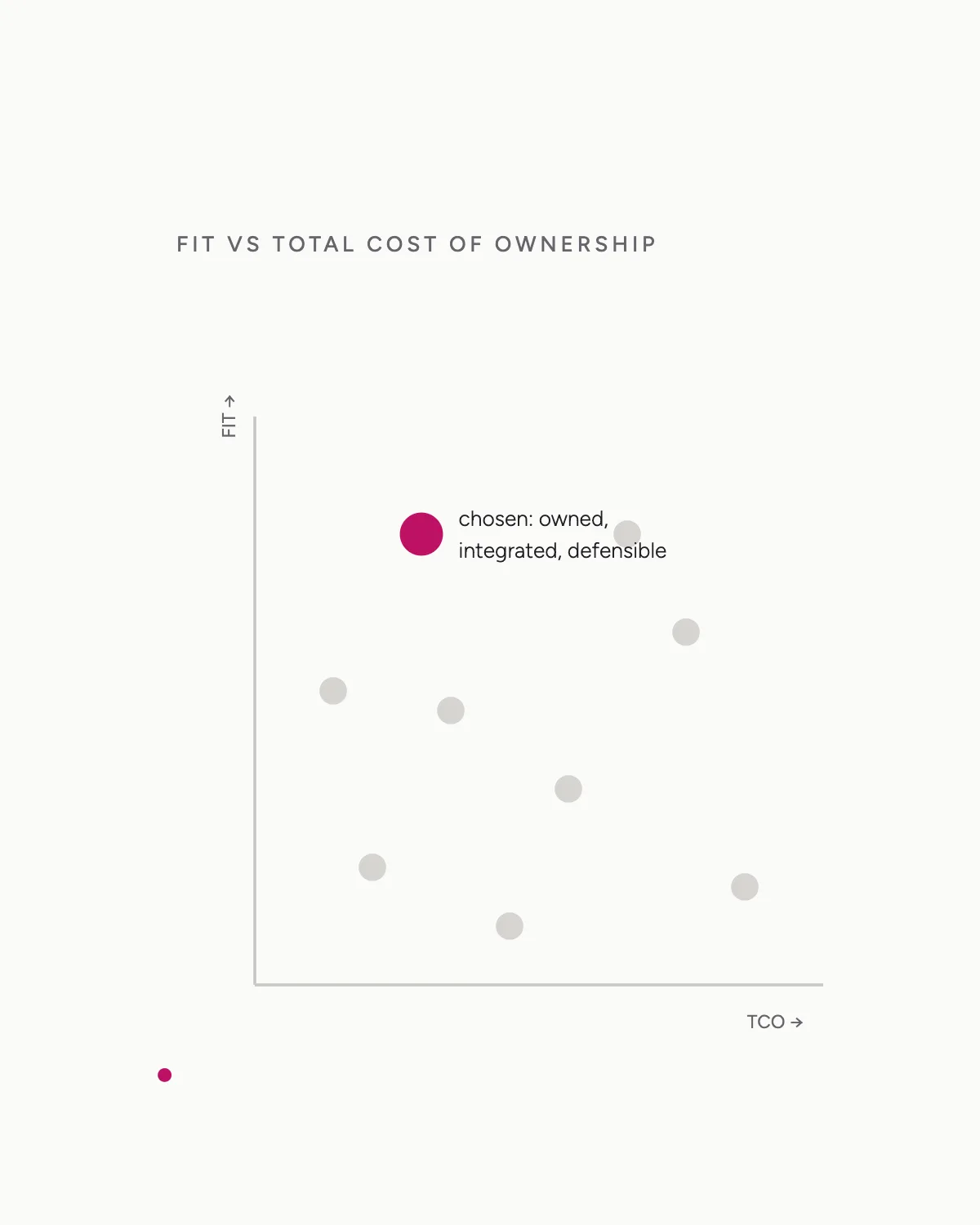
  • A tool selection shortlist scored on fit, ownership and total cost
  • A consolidation plan that retires duplicate and unused licences
  • A business case, built line by line, that finance can defend

The cheapest tool is the one you do not buy

Every platform you add carries a cost beyond the licence: the integration, the admin time, the training, the renewal negotiation. We start by questioning whether you need it at all, then whether you should own it or rent it, then which option fits. The result is usually a smaller, tighter stack that does more. Consolidation is not a cost cutting exercise dressed up as strategy. It is the strategy.

Owned and efficient beats expensive and enterprise

Enterprise suites promise everything in one bill. The catch is that you rent the lot, your data lives in their tenant, and the price only moves one way. We bias toward platforms you can own outright and run on infrastructure you control, then connect them well. You invest in something you keep rather than feeding a licence treadmill that resets every year. Own your stack, own your data, and stop the spend from compounding against you.

What we build

We build the architecture and the case: a current state map, a target stack design, a scored tool selection, a consolidation roadmap and a costed business case. The deliverable is a decision document, not a slide show. It tells you what to buy, what to keep, what to retire and what it all costs.

Selection without the sales pressure

We have no reseller deals and no vendor kickbacks, so the recommendation is the one your business needs. We score tools on fit, ownership terms and total cost of ownership, then put the shortlist in front of you with the reasoning shown. You make the call with clear eyes rather than under a vendor's quarter end pressure.

For the marketing director

You want a stack you can explain and afford. We give you an architecture that maps to how the team actually works, with the tool count down and the capability up. No more discovering a tool you are paying for that nobody uses.

For the RevOps or operations lead

You inherit the joins and the renewals. We hand you a documented target architecture and a consolidation plan you can execute, so the stack stops being a museum of past decisions and starts being a system you designed on purpose.

For the CFO

You want the renewal pile to make sense. We build the business case line by line, showing cost per tool, the saving from consolidation and the return from owning rather than renting. No opaque contingency, no spend you cannot trace to a need.

For the IT or infrastructure partner

You care about ownership, security and audit. We design toward platforms you can host and control, document the architecture, and avoid bolting yet another opaque cloud rental onto an estate you are trying to keep clean.

Talk to us about your stack architecture

Bring your tool list and renewal dates to a short call. We will show you, quickly, where the overlap and the over-spend sit and what the tighter stack looks like.

Brief Us
Brief Us

How this links to the rest of the pillar

Strategy sets the architecture. Integration and configuration then connects it, marketing automation runs on it, and data governance keeps it clean. Decide the shape here and the build that follows is far cheaper and far less risky.

Who tends to call us first

Teams facing a big renewal who suspect they are over-paying. Businesses that have acquired another and now run two of everything. Marketing leaders who cannot draw their own stack on a whiteboard. If any of that lands, the architecture work is the right first step.

Industrial and manufacturing

Your stack has to respect ERP, product data and a long buying cycle. We design architecture that connects marketing to the systems of record without forcing you onto a consumer style suite that ignores how technical buyers actually decide.

Electronics and distribution

High SKU counts, distributor data and channel tiers demand careful tool choices. We have selected and architected stacks for exactly this shape of business, including the connectivity world HMS Networks operates in, where segmentation and routing cannot be afterthoughts.

Channel and IT segments

Channel businesses such as Arrow ECS need partner aware architecture, and IT firms want a stack they can audit. We design for both: tools chosen on ownership and control, not just on the brightest feature list in the demo.

The strategy and the architecture agree

Tool selection should follow the marketing plan, not lead it. We tie the architecture to the decisions made in B2B marketing strategy and stack planning, so you are buying capability the plan actually calls for rather than capability a vendor happened to be selling.

Why Teylu rather than a generic agency

Most agencies do not touch the stack. They take whatever you have and run campaigns on top, mess and all. We design the stack first, because the architecture decides whether the campaigns will ever be efficient. Strategy and build come from one team that agrees with itself.

Why Teylu rather than an enterprise platform

The enterprise vendor's architecture advice always ends with their suite. Ours does not. We are independent of any platform, we favour what you can own, and we will happily recommend against a tool if it does not earn its keep. That is advice you can trust because it is not selling you anything.

You own the architecture and the decision

The map, the scoring, the business case and the chosen stack all belong to you. We document the reasoning so a future hire can understand why the stack looks as it does. The selection is built so you own the tools where it counts, rather than renting capability you can never leave.

Timeline you can plan around

A full stack strategy and selection engagement typically runs three to five weeks: roughly a week to audit, two to design and score, and one to build the case and agree the plan. Fast enough to act on before a renewal, thorough enough to defend the decision afterwards.

Total cost of ownership, not sticker price

A cheap licence with expensive integration and constant admin is not cheap. We score on total cost of ownership: licence, integration, maintenance, training and exit terms. The owned option often wins on this measure even when its upfront number looks larger, because it stops costing the moment you stop paying for what you do not use.

It feeds the wider data picture

The tools you choose shape what reporting and attribution are even possible. We design with data unification and attribution intelligence in mind, so the stack you select can actually answer the questions finance will ask later.

Consolidate first, optimise second

We do not recommend a wholesale rip and replace. The first move is usually to retire overlap and renegotiate or cancel the worst offenders, which frees budget and reduces risk immediately. Then we improve the core in deliberate steps, so the change is steady rather than a single high stakes migration.

A stack that pays for itself

Fewer tools, owned where it matters, chosen on merit and built to last. The architecture work usually pays for itself in the first round of cancelled licences alone. Enterprise grade thinking without the enterprise overhead, and a stack your CFO is glad to fund.

Book a discovery call

The HMS Networks programme began with the architecture right before the spend, and went on to deliver 391% search market share growth and 3,000 sales opportunities in 90 days.

Brief Us
Brief Us

This engagement suits B2B organisations at a decision point about their tools, who would rather choose deliberately than keep accreting software by default.

Industrial and manufacturing teams whose stack has to connect to ERP and product data and respect a long, technical buying cycle.

Electronics and distribution businesses with high SKU counts, channel data and segmentation needs that demand careful tool choices.

Channel and IT firms who want partner aware architecture and a stack they can own, secure and audit.

Any team facing a renewal or a merger that suspects it is paying for overlap and wants the decision made on evidence.

Outcome

A complete inventory and a clear view of overlap, unused licences and the spend that is not earning its keep.

Step 2

Weeks 2 to 3

Design and score. We design the target architecture and score candidate tools on fit, ownership terms and total cost of ownership.

Outcome

A target stack design and a scored shortlist, with the reasoning shown so the choice is yours to make with clear eyes.

Step 3

Week 4

Business case. We build the consolidation plan and the costed case, showing savings from retiring overlap and the return from owning rather than renting.

Outcome

A line by line business case your CFO can sign off, with recurring spend heading down.

Step 4

Week 5

Decision and handover. We agree the plan, sequence the changes and hand to the integration and configuration work, or to your own team.

Outcome

An agreed architecture, a clear roadmap and a clean handover to build, with nothing left ambiguous.

Book a discovery call

If a big renewal is looming, this is the conversation to have first. Bring the contract and we will tell you whether to sign, switch or consolidate.

Brief Us
Brief Us

Diagnostic. We audit the stack, the contracts and the data flows and show you the overlap and over-spend.

Build. We design the target architecture, score the tools and build the consolidation plan and business case.

Embedded. We support the rollout and the renegotiations, or hand the plan to your team fully documented.

Pricing is built line by line against scope, with no opaque contingency, so finance sees exactly what each phase costs and saves. The recommendation always favours what you can own over what you must keep renting. Enterprise grade thinking without the enterprise overhead.

Proof over promises

The architecture decisions we made early for HMS Networks underpinned 391% search market share growth and 3,000 sales opportunities in 90 days. Good selection is invisible when it works, which is exactly the point.

Talk to the team

You will speak to the people who would do the audit and write the business case, not a salesperson. Bring your stack and your worries and we will be straight with you about both.

Start the conversation

No vendor agenda and no jargon. Just an honest read on whether your stack is the right shape and what it should cost.

Brief Us
Brief Us