


.avif)



71-75 Shelton Street
Covent Garden, London,
WC2H 9JQ
On 2 September I stood on Stage 4 at Webflow Conf in Boston and spent twenty five minutes trying to talk a room of agency leaders and marketers out of the instinct that got most of us promoted. The session was called Kill Perfect. Webflow has now sent us the full recording, so here it is, followed by a written version of the argument for anyone who prefers to read.
The assumption the job was built on
The marketing director role rests on one belief: being wrong is expensive. Every habit I was trained in comes from it. The sign off chains, the brand police, the deck about the deck before the deck. None of that exists because marketers love process. It exists because for my whole career a bad idea that reached the market could burn a quarter's budget and a reputation with it. Caution felt like professionalism, and most of us in that room got senior by being good at it.
The result is a machine for shipping the most defensible idea. Nowhere in it is the question "is this the best idea we had?" Those are not the same thing.
The industry describes itself this way. In The Extraordinary Cost of Dull, System1 with Adam Morgan of eatbigfish and Peter Field went through the IPA Effectiveness Databank and found that dull advertising needs around 2.6 times the media spend to achieve the same large scale growth as interesting work. In the United States the extra media money spent forcing dull work to perform is estimated at 189 billion dollars a year. We tell boards we cannot afford creative risk. The data says we are already paying for the risk we refuse to take.
What changed
AI collapsed the cost of building, testing and killing an idea. Not reduced. Collapsed. Work I used to scope as a quarter, a set of landing pages, the copy, the imagery, a live test against real traffic, now compresses into a day to plan and a week to deploy. We have done it repeatedly for clients.
Which flips everything. When testing was expensive, polishing was protection. Now testing is nearly free, so polishing is the gamble. Every week spent perfecting something in a boardroom is a week of real answers you chose not to buy. Perfect is the new reckless.
The window will not stay open. The tools get cheaper every year, so access is no advantage, but the businesses already running hundreds of cheap experiments are banking something you cannot download later: judgement. It compounds from reps. A team that has run two hundred small tests has something a bigger budget cannot shortcut.
We have seen this before. In 2000 Blockbuster passed on buying Netflix for 50 million dollars while turning over six billion a year. Nobody in that meeting was reckless. They chose polished and reliable, and it was the defensible choice every time it was made. What they could not buy back afterwards was the decade of testing and learning Netflix had banked while everyone laughed at DVDs in the post. Cheap access arrived for everybody. It saved no one.
The model: proof of concept on repeat
Four steps, and the discipline lives in the verbs.
Bet. Take a fixed slice of the budget, we run 25%, and put it through the loop deliberately. Get the irrational options on the table on purpose. House rule: if every idea in the round is sensible, reject the round.
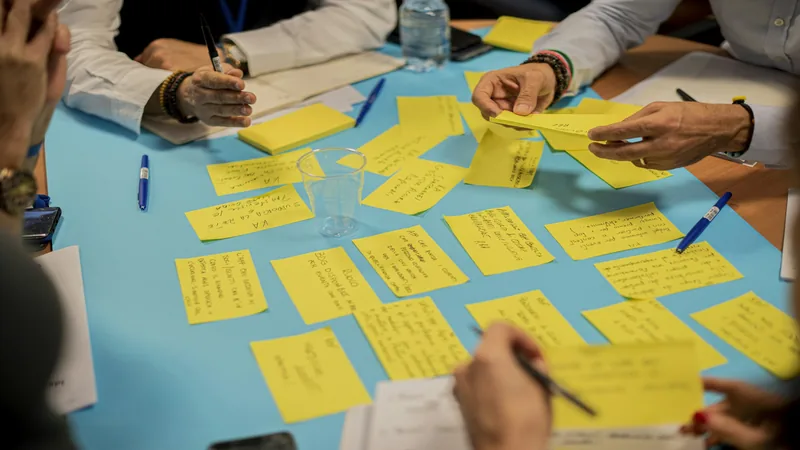
Build. Make the ugly version in an afternoon. Understandable and deployable, not polished. AI does the heavy lifting because speed is what makes the next step affordable.
Expose. Real audience, small money, live within a week. Reality is the reviewer, not the boardroom. Then let your experts judge what it did over a sensible time frame rather than day one vanity metrics.
Kill or scale. If it lost, kill it, log what it taught you and move on. No post mortem longer than the test. If it worked, scale it with the confidence of something that has already survived contact with real customers. The kills are the system working. A clean kill for a few hundred pounds is the cheapest education a team will ever get. Ours go in the wins file.
None of this survives without three things from leadership: a ring fenced budget capped per test with no board approval per idea, a pledge said out loud that failure inside the loop is never a performance issue, and guardrails, meaning the brand guidelines live in the tooling rather than in a four week approval chain. Budget without safety gets you theatre. Safety without guardrails gets you chaos.
What it returned for a client
We run this for real. For a four billion dollar B2B technology business selling through channel partners and direct, we freed 20% of the media budget from targets and ran a two week analysis loop. Instead of the industry norm of roughly four customer problems a year, one polished idea per quarter, the team tackled twenty four.
Cost per confirmed sales ready lead fell 59% globally, against the 12% a standard optimisation programme would have projected. Return on media investment reached 35 to 1, from 11 to 1 the year before. And the number I am proudest of: finance gave the marketing team a 30% budget increase the following year, because the return was sitting in front of the sales and finance teams in black and white.
The CFO conversation has three moves. Cap the downside and uncap the upside by agreeing the slice up front. Change the metric from campaign ROI to cost per validated lesson. Move the comparison line so the whole budget is judged against last year's whole budget, not the test slice against its own P and L.
What came back from Boston
The best part of speaking is what happens in the fortnight afterwards. Webflow put every session on demand on the Webflow Conf website the week after the event, then released the full recording to us for our own channels, which is why you can watch it above. The conversations at the venue turned into follow ups the following week: a referral partnership discussion with a US payments provider we met at the conference, an introduction to Webflow's enterprise team that is now progressing, and a first look at Source by Webflow, which we are already talking to partners about.
The question the talk spends its last third on is the one every marketing leader ends up asking: how do I get this approved? That is why the close is about the leadership conditions and the CFO defence rather than the tooling. The tooling is the easy part.
What happens next
Kill Perfect is now a product as well as a talk. The loop above, the proxy ladder we use to judge B2B tests before revenue lands, the reporting templates and the register that turns closed tests into data nobody else has are being packaged so a marketing team can install it without hiring us. The full write up of the method is coming to this blog in October, and we are running a free online workshop on Thursday 29 October for marketing leaders who want to see the loop run end to end.
If you take one thing from the talk, make it the Monday morning question: what is the cheapest way to find out if we are right or wrong? Ask it in your first meeting back. And if you want to talk it through, email me at sam.shrimpton@teyluandpartners.com. I would love to hear what you kill first.
Frequently asked questions
What is Kill Perfect?
Kill Perfect is the testing operating model Teylu runs for B2B clients: bet, build, expose, kill or scale, on a capped and ring fenced slice of budget, with the decision rules agreed before a test goes live. It was presented as a session at Webflow Conf 2026 in Boston on 2 September 2026.
Where can I watch the Kill Perfect talk?
The full 25 minute recording is embedded on this page and on Teylu's YouTube channel. The session was also available on demand to online attendees through the Webflow Conf website.
What does "perfect is the new reckless" mean?
When testing was expensive, polishing an idea before launch was protection. AI has collapsed the cost of building and testing, so time spent polishing in a boardroom is now time spent not buying real answers from real customers. The safe option is no longer the cheap option.
How much budget should go into testing?
The talk recommends a fixed 25% slice, capped per test and free of board approval per idea. If 25% is not available, start at 10% and protect it. The principle matters more than the number.
