The planning. We decide which accounts to pursue, tier them, map the buying groups and write the playbooks. The campaigns that work that list sit with our Account-Based Marketing delivery pillar, which runs against the plan this engagement produces.



A target list of two hundred is not a target list. We decide account selection, tiering and playbooks with you before anyone runs a single ABM campaign.

.svg)
.svg)
.jpg)
.svg)
.svg)
Results our clients report to their boards
35:1
Your media return, if your campaign runs like HMS Networks' first one did
35:1
Your media return, if your campaign runs like HMS Networks' first one did
35:1
£760 to £72
£760 to £72
£760 to £72
1,588
£760 to £72
What HMS now pays for a confirmed sales ready lead, down from a typical trade event lead
1,588
Sales ready leads HMS generated on reporting they own and operate
42x
Media efficiency Arrow ECS achieved against benchmark with VMware
The discipline in ABM is saying no. A target list of two hundred accounts is not a strategy, it is a wish. We work with you to define the accounts that genuinely fit, score them on value and winnability, and tier them so effort matches opportunity. The list that comes out is shorter, sharper and defensible. The team knows exactly who they are pursuing and why, before any budget is spent reaching them.
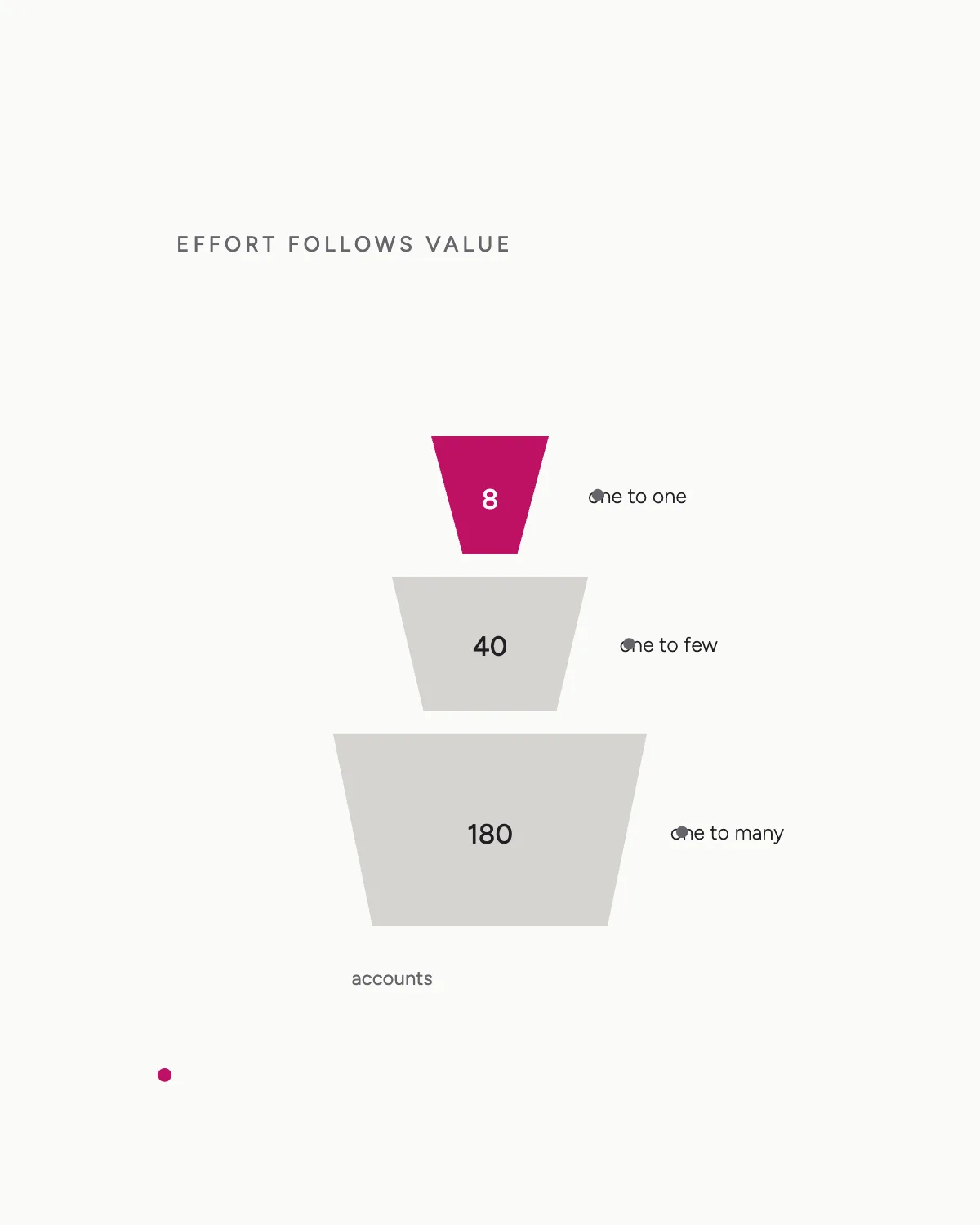
Not every target account deserves the same investment. We build a tiering model: a small set of strategic accounts that warrant one-to-one effort, a middle tier handled one-to-few, and a broader tier run one-to-many. The model tells the team where to spend their time, so the most valuable accounts get the attention they justify and nobody burns a week on a name that was never going to convert.
Account-based marketing fails when activation starts before the thinking is done. A target list gets assembled in a hurry, every account is treated the same, and the programme spreads effort thinly across names that were never worth pursuing. Account-Based Marketing Strategy puts the planning first. We define the accounts worth winning, tier them by value and fit, map the buying group inside each, and write the playbooks before a single touch goes out. This is the advisory work that decides where ABM effort is aimed.
We plan ABM for technical, high-value B2B businesses where a handful of accounts can move the year. The same selectivity that drove results for HMS Networks, where focused work contributed to a 35:1 media return and a cost per sales ready lead cut from around £760 to £72, applies here. When the plan is set, it hands cleanly to our Account-Based Marketing delivery work, and the account data and playbooks stay yours to own.
Account-based marketing fails when activation starts before the thinking is done. A target list gets assembled in a hurry, every account is treated the same, and the programme spreads effort thinly across names that were never worth pursuing. Account-Based Marketing Strategy puts the planning first. We define the accounts worth winning, tier them by value and fit, map the buying group inside each, and write the playbooks before a single touch goes out. This is the advisory work that decides where ABM effort is aimed.
We plan ABM for technical, high-value B2B businesses where a handful of accounts can move the year. The same selectivity that drove results for HMS Networks, where focused work contributed to a 35:1 media return and a cost per sales ready lead cut from around £760 to £72, applies here. When the plan is set, it hands cleanly to our Account-Based Marketing delivery work, and the account data and playbooks stay yours to own.
Account-based marketing fails when activation starts before the thinking is done. A target list gets assembled in a hurry, every account is treated the same, and the programme spreads effort thinly across names that were never worth pursuing. Account-Based Marketing Strategy puts the planning first. We define the accounts worth winning, tier them by value and fit, map the buying group inside each, and write the playbooks before a single touch goes out. This is the advisory work that decides where ABM effort is aimed.
We plan ABM for technical, high-value B2B businesses where a handful of accounts can move the year. The same selectivity that drove results for HMS Networks, where focused work contributed to a 35:1 media return and a cost per sales ready lead cut from around £760 to £72, applies here. When the plan is set, it hands cleanly to our Account-Based Marketing delivery work, and the account data and playbooks stay yours to own.
If your target account list was assembled in a rush, a short planning conversation is the quickest way to find out which names actually belong on it.
This fits if you are
This engagement suits B2B businesses where a small number of high-value accounts can move the year, and where getting the target list right matters more than reaching volume. It fits four situations in particular.
Businesses with a few defining accounts whose win or loss shapes the year, and who cannot afford to aim ABM at the wrong names.
Teams running ABM that is not landing, where effort is spread too thinly across a list that was never properly chosen.
Industrial, electronics, manufacturing and distribution firms with complex buying groups and channel structures that a flat target list ignores.
Marketing and sales leaders who need to align on which accounts they are jointly pursuing and how.
Not the right engagement if
1
Weeks 1 to 2
Account discovery and scoring. We define the ideal account profile, build the scoring model and assess your market against it to find the accounts genuinely worth pursuing.
A scored, defensible target account list, agreed with sales, that everyone can justify.
2
Weeks 2 to 3
Tiering and buying group mapping. We tier the accounts by value and fit, then map the buying group inside each tier.
A tiering model and buying group maps that decide where one-to-one, one-to-few and one-to-many effort goes.
3
Weeks 4 to 5
Playbook design. We write tier-specific playbooks covering messaging, channels and sequence for each level of the programme.
Practical account playbooks the team can pick up and run, tailored to each tier.
4
Week 6
Measurement and handover. We agree the engagement and pipeline metrics, then brief the delivery team that will run the programme.
An agreed measurement framework and a clean handover to Account-Based Marketing delivery.

35:1
Return on media investment. Cost of a qualified lead cut from around £760 at trade events to around £72 online, with 1,588 sales ready leads on reporting HMS owns and operates.
Read the case study

454,176
Campaign views at 42x media efficiency, six times the target, with account level intelligence the sales team trusts. Enterprise distribution made measurable.
Read the case study
Good account selection depends on good data. This work links to Data Unification so the account list is built on a single, clean view, and to Marketing Dashboards so engagement can be tracked once the programme runs.
Against an enterprise agency
Quarters, not weeks
Six month discovery phases and a quarter million before a single dashboard exists. We work in weeks, with senior people on every call and pricing itemised line by line.
The thread through our work, from HMS Networks in industrial connectivity to technology distribution with Arrow ECS, is focus. Concentrating effort on the right targets, rather than spreading it thin, is what makes the same budget deliver more.
We work in stages. Stage one is the account selection, tiering and playbook design that produces a launch-ready plan. Stage two, if you want it, keeps us alongside the team as the programme runs so the list and tiers adapt as accounts respond. Pricing is built line by line against scope, with no opaque contingency, so finance sees exactly what each stage buys. The account data and tooling the plan points to are owned and operated by you, never a rented platform you cannot leave. Enterprise grade thinking without the enterprise overhead.

"Complete dedication to our brand mission by Teylu. They worked within our limitations and made our marketing profitable on first purchase."

Ken Price
CEO, Blake Mill Menswear
"Teylu delivered rapid activation, delivered immediate sales uplift. Assisted in delivering a business exit and increased valuation."

Katie Dixon
Founder, Evellier Luxury Intimates
"It's a pleasure to work with the whole Teylu team. They delivered our exact brief quickly to great effect. What more can you ask for?"

Sophie Fresson
Head of Digital, Oceana UK
Is this the ABM campaigns, or the planning behind them?
The planning. We decide which accounts to pursue, tier them, map the buying groups and write the playbooks. The campaigns that work that list sit with our Account-Based Marketing delivery pillar, which runs against the plan this engagement produces.
We already have a target account list. Why plan again?
Most lists we see were assembled quickly and never scored. The question is whether each name on it can be justified on value and winnability, and whether the effort is tiered to match. If the list cannot survive that test, the activation is aimed at the wrong accounts and the budget is already at risk.
Do we own the account list and playbooks, or are they tied to you?
They are entirely yours. The scored list, the tiering model, the buying group maps and the playbooks belong to you, and the plan points the build towards account data and tooling you own and operate rather than a rented ABM platform. Your account intelligence stays with you when any engagement ends, and the cost goes into infrastructure you keep rather than a subscription that takes the data with it.
How long before we have a launch-ready plan?
Four to six weeks from kickoff: account list, tiers, buying group maps and playbooks. Fast enough to launch within the quarter, and thorough enough that the list will hold up when someone asks why these accounts and not others.
How do you get sales aligned on the accounts?
We bring sales into the selection and tiering from the start, because ABM only works when both teams pursue the same named accounts. The list is jointly owned by the end of the engagement, and the playbooks reflect what sales will actually do rather than what marketing hopes they will.
Bring your target account list. One session is usually enough to show which names belong on it and which are draining the budget.
Tell us where the data lives and what the board keeps asking. A senior person reads every one of these.
What happens next

