


.avif)




71-75 Shelton Street
Covent Garden, London,
WC2H 9JQ
Most brand strategy decks die in the cloud. They get presented, applauded, archived, and then absolutely ignored the next time someone needs a homepage hero, a product name, or a way out of a margin squeeze. That is not a brand strategy. That is decoration.
This guide is the opposite of that. It is the working version of how I build brand strategies for the founders I sit beside, whether they are running a digitally native fashion label out of a converted barn in Cornwall or a 40 year old engineering business that sells through 12 distributors in eight countries. It will take you from a blank page to a brand strategy you can actually run a business with, and it will not pretend the work is glamorous.
A quick promise before we start. Every step has two practical playbooks attached. One for D2C ecommerce founders selling direct without physical stores. One for B2B brands who do most of their selling through partners, distributors and resellers. The principles are universal. The execution is not. If your business does not fit either profile cleanly, take what is useful from both.
What this guide covers
This is the long version. The short version, if you only have ten minutes, lives over at How to Build a Brand Strategy: a founder's field guide. Come back when you want the full playbook.
Here is the spine.
- Why brand strategy still beats budget in 2026
- The five questions every brand strategy must answer
- Step 1: Diagnose where you actually are
- Step 2: Define who you are for, and who you are not
- Step 3: Find your wedge, the one distinctive idea
- Step 4: Build the message architecture
- Step 5: Codify the verbal and visual identity
- Step 6: Choose your channels and build a content engine
- Step 7: Wire brand to commercial outcomes
- Step 8: Measure what matters
- Step 9: Govern the brand as you scale
- The five mistakes that kill most brand strategies
- A two page template you can fill in tonight
- FAQ
It is roughly a 25 minute read. It will save you 25 weeks of avoidable mistakes.
Why brand strategy still beats budget in 2026
The biggest myth in marketing is that the brand with the biggest budget wins. It does not. The brand with the sharpest thinking wins, and brand strategy is how you put sharp thinking on the page in a way the rest of the business can act on.
In 2026 the case is even stronger than it was five years ago, for two reasons.
First, AI driven discovery has flattened the playing field. When your future customer asks ChatGPT, Perplexity or Google's AI Overview to recommend "the best sustainable activewear under £150", the engine does not care how much you spent on banner ads last quarter. It cares whether the open web has clear, consistent signals that your brand exists and stands for something. A brand strategy is the source code those signals are generated from. We unpacked the wider implications of this shift over in The industries set to win big from AI in marketing this year.
Second, paid media is more expensive than ever. Meta, Google and TikTok all want the same thing from you, which is more cash for fewer impressions. The only sustainable defence is a brand customers actively look for, talk about and forgive when something goes wrong. That is brand equity, and you can only build it deliberately. We dig into how this plays out in fashion specifically in CRO in fashion ecommerce.
Brand strategy is the lever that makes every pound of paid media work harder, every email convert better, every product launch land softer. It is also the only piece of work that compounds. Done badly it costs you nothing today and quietly bleeds you for years. Done well it pays you back for as long as the business exists.

The five questions every brand strategy must answer
Before any frameworks, write down the five answers. If you cannot answer these in plain English, you do not have a brand strategy yet. You have a wishlist.
- Who is this for, specifically.
- What problem are we solving for them, in their words.
- Why us, and not the obvious alternative.
- What do we want them to feel, think, and do.
- How will we know it worked.
Every other piece of strategy work is a more detailed version of one of those five answers. If your current strategy doc cannot connect every page back to one of those questions, the doc is too long.
Step 1: Diagnose where you actually are
Strategy without diagnosis is guessing. Before you write a positioning line or commission a logo, you need a clear, unromantic picture of three things: the market you are operating in, the customer's actual experience of you, and the truth of what you do well today.
Run these five exercises before anything else.
A revenue audit. Pull last 12 months of revenue and segment it by product, channel, customer type and acquisition source. The vast majority of brands discover that 70 to 80 percent of revenue comes from a much narrower slice than they thought. That slice is your gravitational centre. Build outward from it.
A category audit. Map your top eight to twelve competitors on a single page. For each, capture their positioning line, their hero proof, their primary channel and their pricing. Print it out. Patterns will jump off the page. The unclaimed space in those patterns is where your brand can live.
A customer voice audit. Read 50 reviews of your brand and 50 of competitors. Read them in batches. Highlight the words that come up repeatedly, both positive and negative. Customers will hand you your positioning if you let them. We use this technique on every brand engagement we run.
A search and AI audit. For your top ten head terms and ten long tail queries, look at the first page of Google and the AI Overview. Notice who appears repeatedly. Notice the language those pages use. Notice what is missing. The whitespace is your brief.
A team interview. Ten conversations of 30 minutes each, across sales, customer service, ops and product. Ask them what customers ask, what they push back on, what they reorder, what they recommend. The team usually knows the brand better than the marketing department does.
Output of Step 1: a one page diagnosis with your top three commercial truths, your top three category truths, your top three customer truths.
How D2C ecommerce founders apply this step. Your data is probably better than you think. Your Shopify, Klaviyo, Meta and Google accounts contain the entire diagnosis. Lean on order tags, returns reasons, repeat purchase rates and email reply text. Run one founder hosted Zoom call with five of your top customers. They will tell you, in their words, what your brand actually sells. Resist the urge to push features. Listen for emotion.
How B2B brands selling through distributors apply this step. Your data is messier and the customer is two layers away. You need to interview both ends, the distributor and the end user. Get on the road with three of your best distributors, sit in their van or visit their counter for a day, and watch them try to sell your product. You will learn more in eight hours than in eight months of slide decks. Triangulate the distributor's view with five end user interviews, ideally on site, and a desk read of trade press in your category.
Step 2: Define who you are for, and who you are not
Most brands die from being too welcoming. They define their audience as "anyone who appreciates quality" or "ambitious businesses that want to grow". That is not an audience. That is a description of the planet.
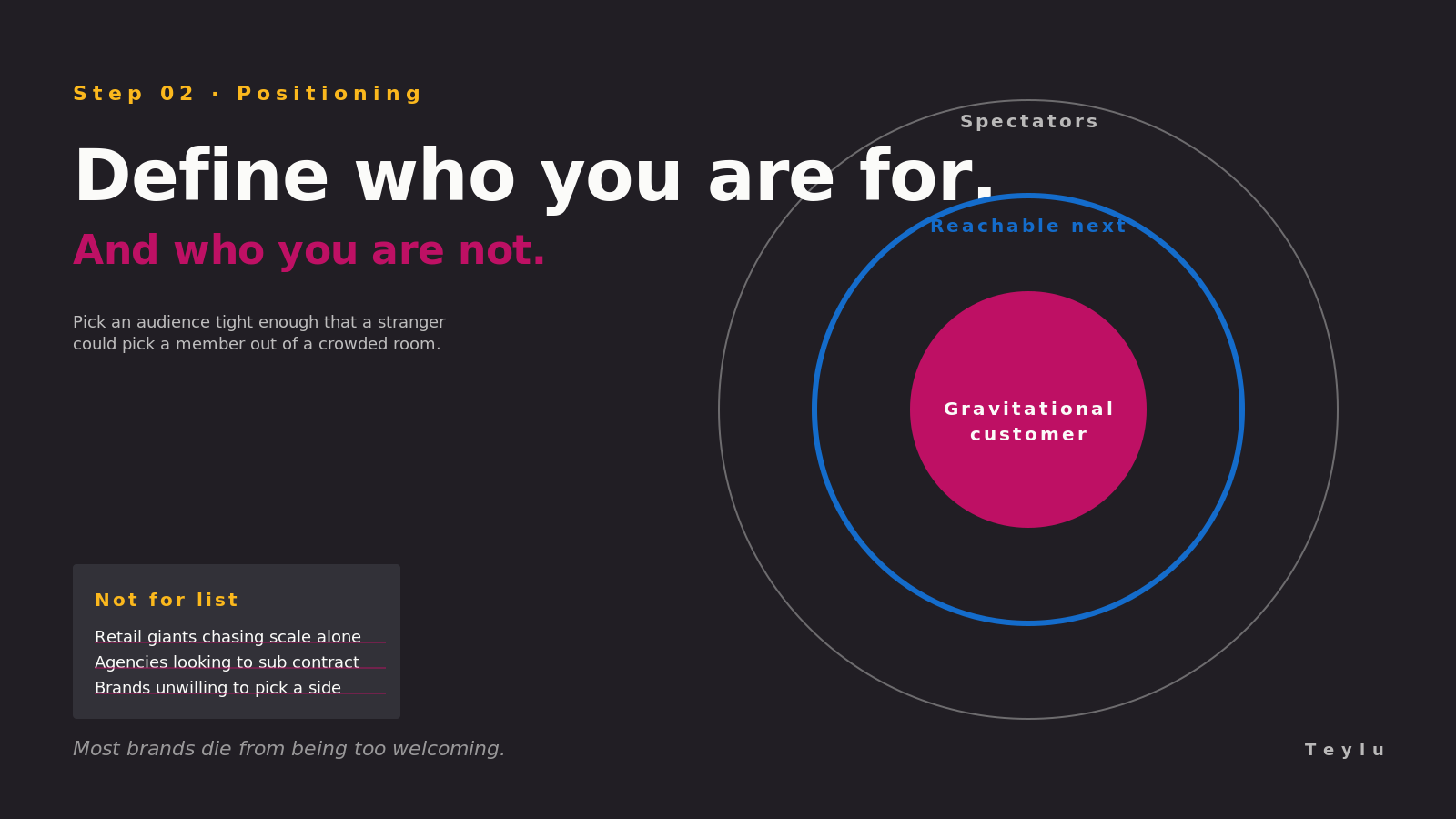
Pick a primary audience tight enough that a stranger could pick a member out of a crowded room. Then write a second list of who you are explicitly not for. The not list is more powerful than the for list, because it is the list that gives you permission to say no.
A useful working format is the Three Concentric Circles.
The inner circle, your gravitational customer. The 20 percent of customers who give you 80 percent of revenue today. They are the audience your brand is being built to delight. Describe them in 200 words. Where do they live, what do they do, what other brands do they buy, what do they say about you, what would they pay double for, what would they walk over hot coals for.
The middle circle, your reachable next customer. People who look like the inner circle but do not yet know you. This is your acquisition target. The brand strategy needs to be visible to them through clear language, recognisable positioning, and content that speaks to their actual problem.
The outer circle, the brand spectators. Industry, press, peers, recruits. They are not your customer but they shape your reputation. Their version of your brand needs to make sense too.
Output of Step 2: a one page audience definition with the three circles, plus a "not for" list of three to five customer types you will deliberately decline to serve.
How D2C ecommerce founders apply this step. Treat your customer file as the audience document. Look at lifetime value cohorts, returns rates and product mix by customer segment. The customers that make the business viable are not always the customers your founder story remembers. Be honest with the data, then write the brand for the version of the customer the data tells you to.
How B2B brands selling through distributors apply this step. You have two audiences, not one. The distributor or partner is the buyer. The end user is the customer. They want different things. The distributor wants margin, sell through, reliable supply, easy reorder. The end user wants outcomes, status, performance, peace of mind. Your brand needs to speak to both, in different places, in different language. Build a separate "distributor circles" page alongside the "end user circles" page. Make peace with the fact that the brand has to do double duty.
3: Find your wedge, the one distinctive idea
A brand is a position in the customer's head. Position theory is 50 years old and still wins. The brain has limited shelf space. It will only file you under one idea. Pick the idea, or the market will pick a worse one for you.
The wedge is the single sentence that compresses your brand to its smallest defendable claim. It has three jobs.
Differentiate. It separates you from the obvious alternative. Resonate. It maps onto something the customer actually wants. Defend. You can prove it, today, with current capability.
Two methods for finding the wedge.
The contradiction method. Write down the unwritten rule of your category. Then ask, what would happen if we did the opposite. Most great brands sit on a contradiction. Premium quality at fast fashion delivery. Enterprise expertise without enterprise overhead. A bank that does not feel like a bank. A coffee chain that knows your name. Your wedge often hides on the other side of an industry assumption.
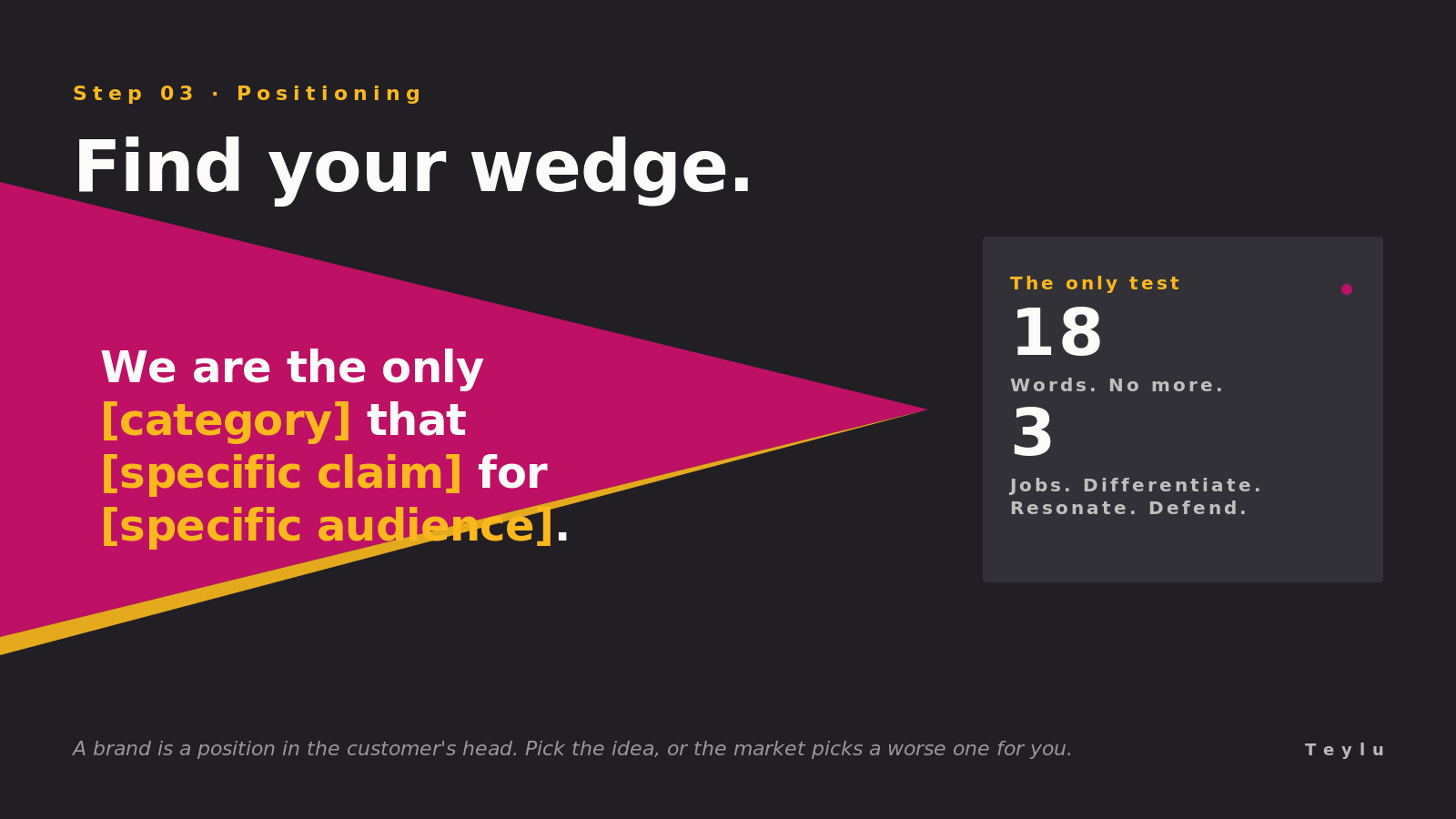
The "only" test. Try to finish this sentence: "We are the only [category] that [specific claim] for [specific audience]." If you cannot finish it without flinching, keep going. Push the specifics until you find one nobody else can make. Specificity is the friend, not the enemy, of breadth.
Output of Step 3: a single sentence wedge, no more than 18 words, written six different ways and pressure tested with three customers, three team members and one trusted outsider before you pick the final version.
How D2C ecommerce founders apply this step. The wedge has to survive a five second product page test. If a stranger lands on a product detail page, do they understand within five seconds what you are and why they should care. If not, the wedge is too soft, or the design is hiding it. Run five user tests with strangers and watch how they read the page. The wedge gets sharper after the third test, every time.
How B2B brands selling through distributors apply this step. The wedge has to survive the trade show test. Imagine your distributor's salesperson at a counter, with 30 seconds to explain you to a tradesperson holding a basket. Can they say it without notes. Can they remember it three weeks later. The wedge that wins is the one your distributor's team can say in their sleep, because they will need to. Build the wedge with them in the room.
Step 4: Build the message architecture
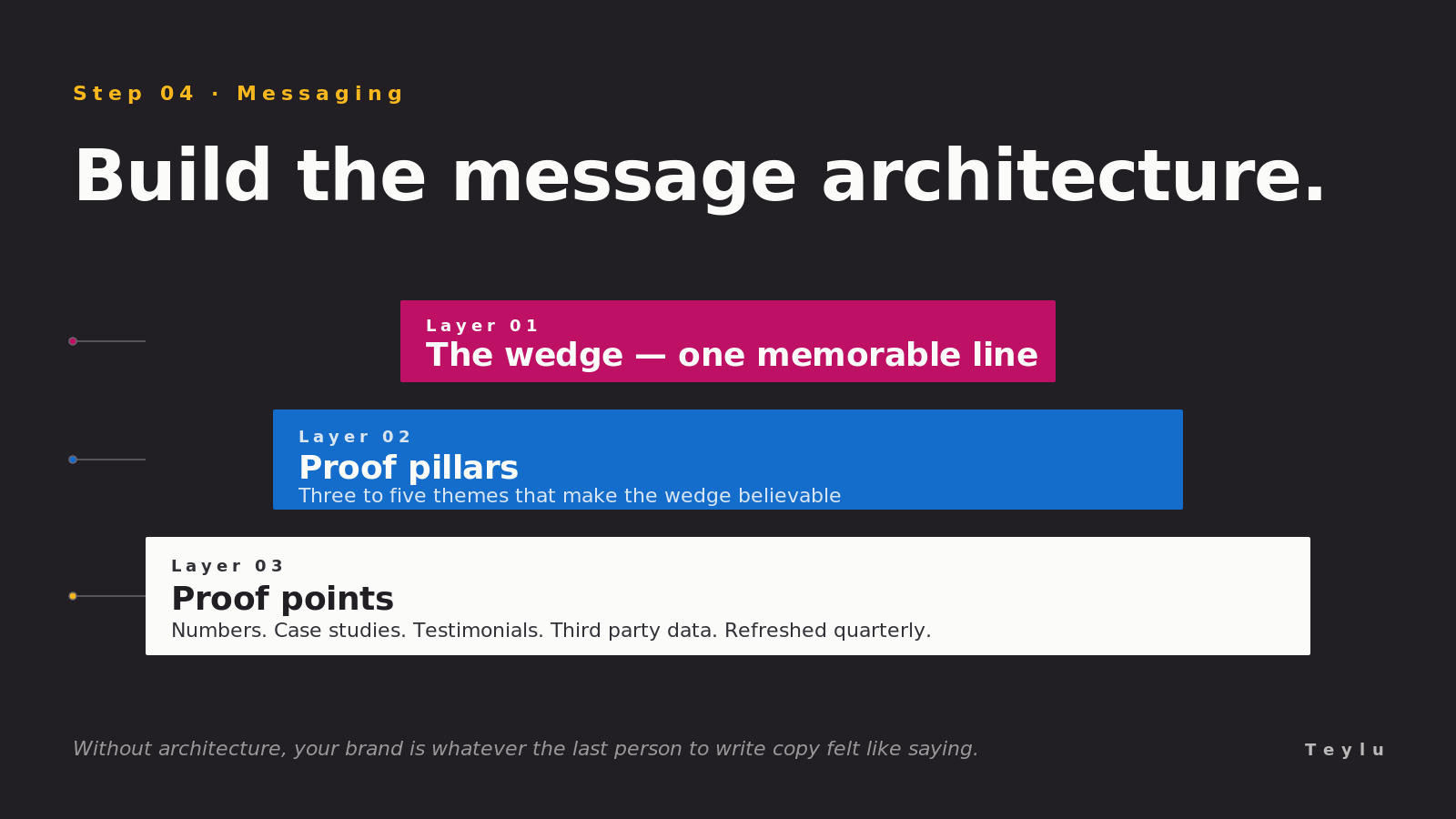
The wedge is the headline. Underneath it sits an architecture that lets the brand speak coherently across every situation. Without architecture, your brand is whatever the last person to write copy felt like saying.
Use this three layer model.
Top layer, the wedge. One line. Customer facing. Memorable. Defendable.
Middle layer, the proof pillars. Three to five themes that make the wedge believable. For a sustainable activewear brand the pillars might be circular materials, fair manufacturing, performance fabrics, lifetime repair. For a B2B engineering brand they might be 40 year track record, in house testing, on time delivery, named technical lead per account. The pillars are how the brand keeps its promise.
Bottom layer, the proof points. The hard, specific evidence under each pillar. Numbers, stories, case studies, third party data, customer quotes. Refresh these quarterly. Without them the architecture is empty.
Each pillar should answer a different objection a buyer might raise. If two pillars do the same job, collapse them into one.
Output of Step 4: a one page message architecture with the wedge, three to five pillars, and three to five proof points beneath each pillar.
How D2C ecommerce founders apply this step. The architecture maps directly to your site information architecture. The pillars become category pages, About story, sustainability page, reviews hub. The proof points populate product page collapsibles, email content, paid social hooks. If you cannot map a pillar to a piece of the site, either the pillar is wrong or the site is.
How B2B brands selling through distributors apply this step. The architecture maps to your sales enablement library. The pillars become the sections of the line card or partner pack. Proof points become case studies, accreditations and product cut sheets. The distributor's salesperson should be able to flip to any pillar and find a slide, a stat and a story to use in 30 seconds. If they cannot, you do not have a sales kit, you have decoration.
Step 5: Codify the verbal and visual identity
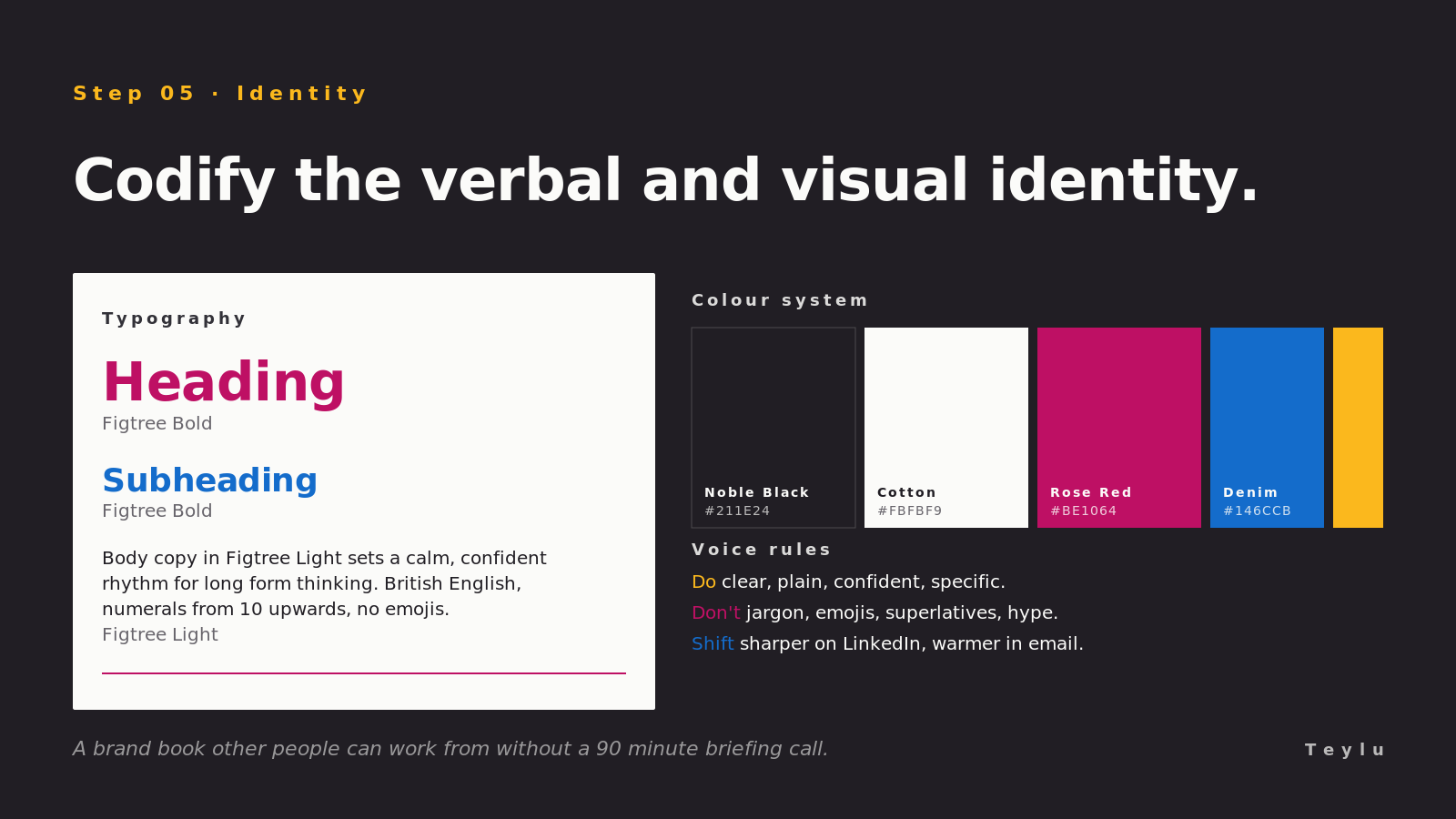
This is where most brand strategies stop being read and start being looked at. That is fine, as long as the visual and verbal identity are clearly downstream of the wedge and architecture, and not their replacement.
Verbal identity. Define five things. The voice (how it sounds). The tone (how it shifts in different contexts). The vocabulary (the words you always use and the ones you never use). The naming convention (how products, ranges, features get named). The grammar rules (British English, no emojis, no hyphens in body copy, numerals from 10 upwards, that sort of thing).
Visual identity. Define eight. Logo and lockup rules. Colour system, primary and secondary. Typography hierarchy. Photography direction. Illustration direction. Iconography. Motion principles for video and UI. The art direction "do not list" so you stop reverting to category clichés.
A common mistake is to treat verbal and visual as a designer's job. They are not. Verbal identity belongs with the brand strategist. Visual identity belongs with the brand strategist working closely with a senior designer. Either decision made in isolation will fight the wedge inside six months.
Output of Step 5: a brand book, 30 to 60 pages, that any new agency, freelancer or hire could open and produce on brand work without a 90 minute briefing call.
How D2C ecommerce founders apply this step. Build a "thumbnail test" version of the visual identity. Open Instagram Stories, your homepage, three product cards, an email and a paid social ad, all at thumbnail size. Can you tell they are the same brand from across the room. If not, the visual system is not assertive enough yet.
How B2B brands selling through distributors apply this step. Visual identity is multi master. Your brand has to look like itself when it is laid into a distributor's catalogue, on co branded vehicle livery, on a trade show pop up, on your own website, in a partner's email signature. Build the visual system to perform under the worst conditions, not the best, because that is where it will live most of the time.
Step 6: Choose your channels and build a content engine
A brand that nobody encounters is a private hobby. Channel choice is a strategic decision, not a media buying one, and it should fall out of the audience and message work you have already done.
Use this five point filter for every channel you consider.
- Does my audience use this channel daily.
- Can I produce content here at the standard the platform rewards, with the resources I have, every week, for two years.
- Does the channel let me show, not just tell, the proof pillars.
- Can I attribute outcomes here, even imperfectly.
- What does winning look like in 12 months.
If you cannot answer all five with confidence, do not start. Pick three to five primary channels. Do them properly. Resist the urge to be on every channel because a competitor is. They are probably losing money there.
Output of Step 6: a channel plan with primary, secondary and dormant channels, plus an editorial calendar for the next 90 days that lives in one place the whole team can see.
How D2C ecommerce founders apply this step. A normal D2C stack in 2026 looks like organic short form video on TikTok and Reels, a paid Meta and Google Performance Max engine, an SEO content programme that targets both Google and AI engines, an email and SMS lifecycle in Klaviyo, and a creator partnership programme. Five channels, run well, will outperform fifteen run badly. We covered the maths of paid in detail over on the performance marketing service page.
How B2B brands selling through distributors apply this step. The channel mix splits into "to the trade" and "to the end user". To the trade you have trade press, trade events, distributor newsletters and field sales. To the end user you have search, LinkedIn, niche communities and increasingly TikTok for trade users in their 20s and 30s. Both stacks need brand led content that the distributor can co opt and rebadge. If your channel plan only talks to the distributor or only to the end user, you will under perform.
Step 7: Wire brand to commercial outcomes
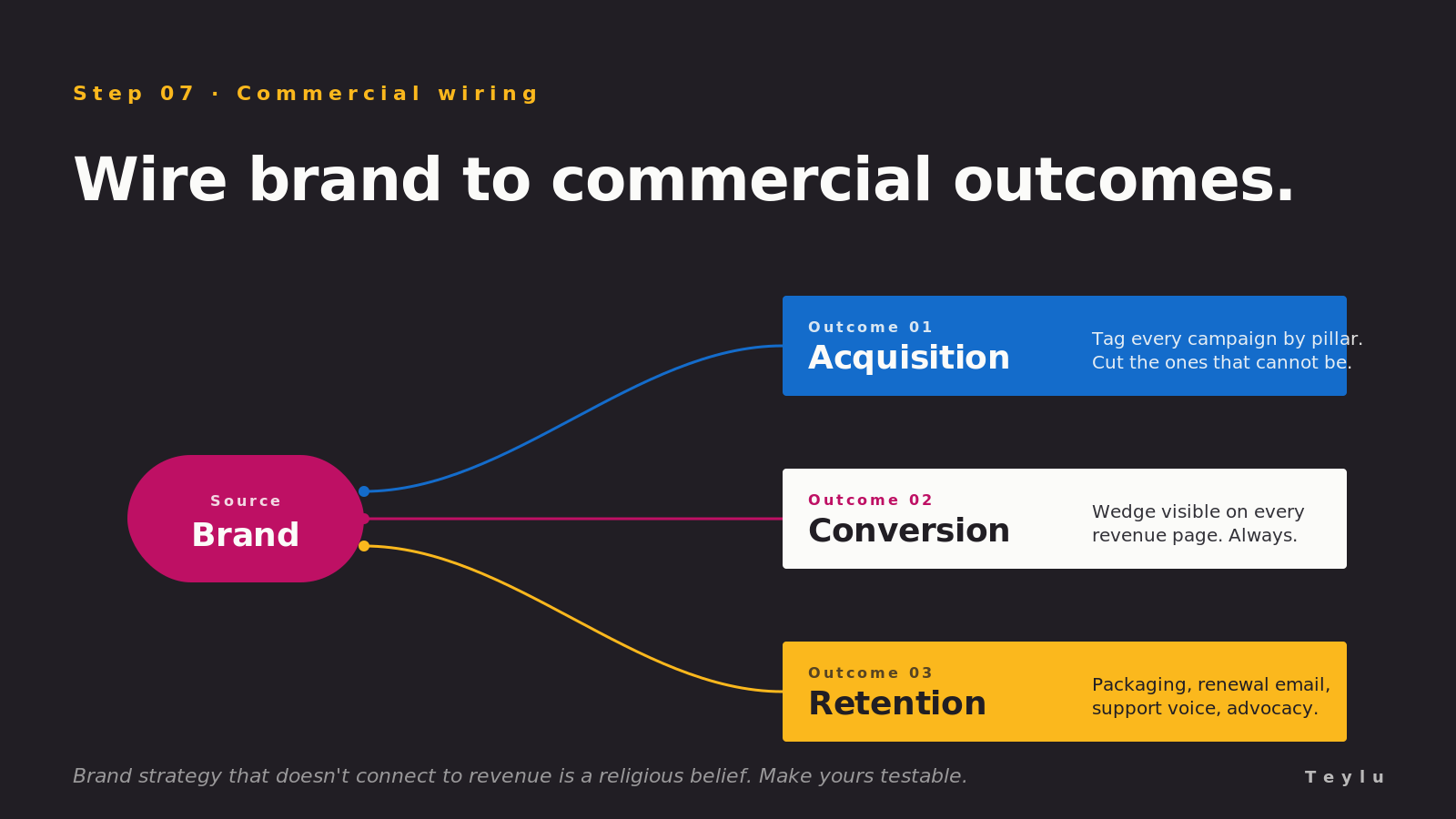
This is the step most agencies skip and most founders desperately want. Brand strategy that does not connect to revenue is a religious belief. Make yours testable.
Three connections to wire in.
Brand to acquisition. Every paid campaign, every piece of content, every PR moment should be working a specific pillar. Tag campaigns by pillar. Report by pillar. You will quickly see which pillars are pulling and which are wallpaper.
Brand to conversion. Your wedge and pillars should be visible on every revenue page. The product detail page, the pricing page, the lead form, the trade application page. If the brand is invisible at the moment of decision, you are paying for awareness without harvesting it. We unpack this in What is conversion rate optimisation, really and the conversion rate optimisation service page.
Brand to retention. The post purchase journey, the support voice, the packaging insert, the renewal email. These are the moments that turn one off buyers into advocates. They are also the moments most brand strategies forget. Fix this and your CAC payback halves.
Output of Step 7: a one page commercial map showing how each pillar drives a measurable outcome at acquisition, conversion and retention, with the named owner per outcome.
How D2C ecommerce founders apply this step. Build a quarterly "brand to till" review. Pull paid CAC by creative concept, on site conversion rate by hero variant, repeat rate by post purchase email cohort. Map the wins back to the pillar they expressed. Cut the campaigns whose pillar cannot be identified, regardless of their short term ROAS. Short term wins that contradict the brand are long term losses.
How B2B brands selling through distributors apply this step. Build a quarterly "brand to distributor" review. Pull sell through by SKU and by partner, the win rate of co branded campaigns, the lead quality from gated content. Sit with the top three distributors and ask them where the brand is helping them sell and where it is in the way. Their answers will rewrite parts of the strategy. Take notes.
Step 8: Measure what matters
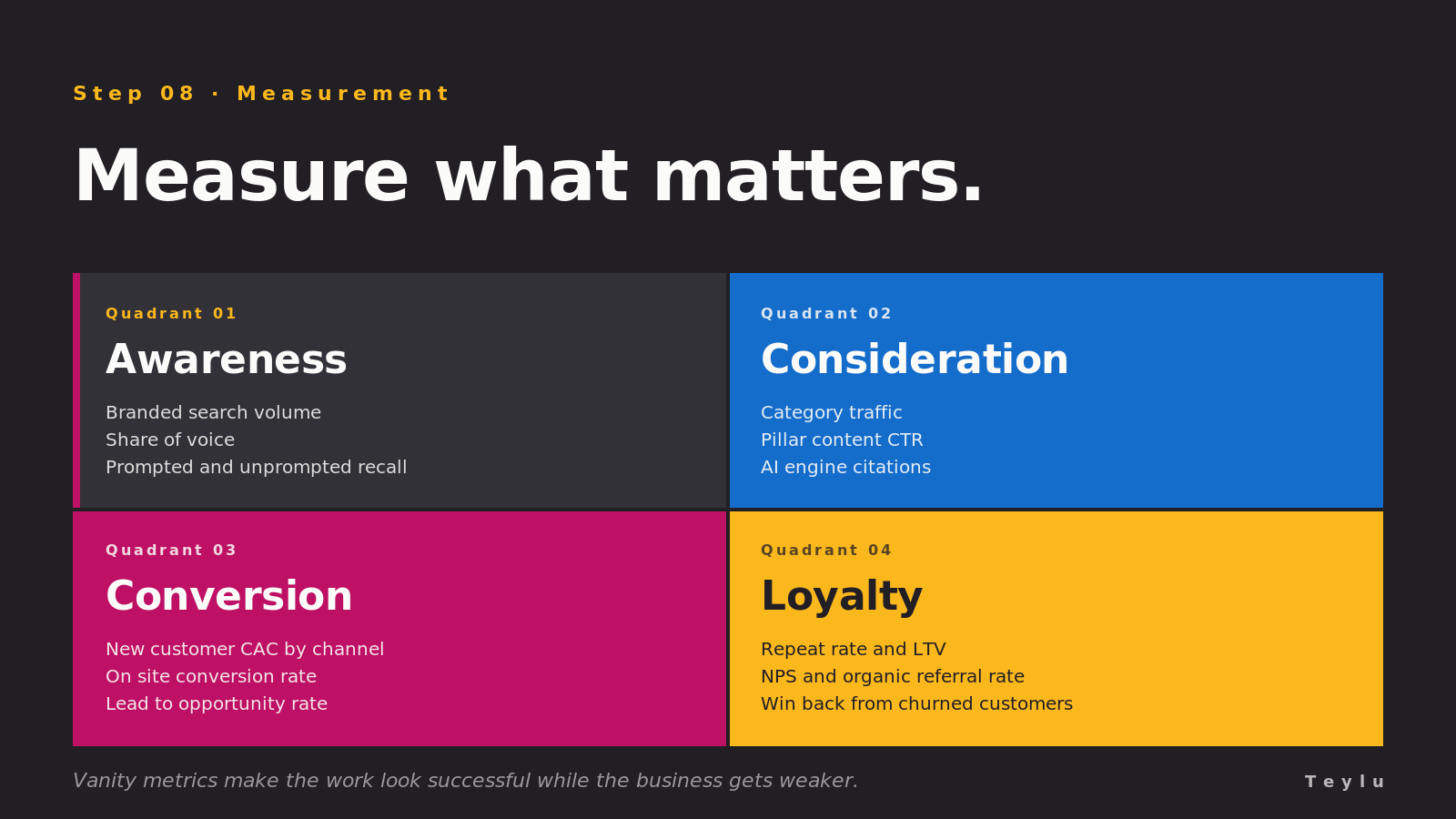
Vanity metrics are the silent killer of brand strategies, because they make the work look successful while the business gets weaker. Build a measurement frame that the CFO would sign off on.
Use a four part scorecard.
Awareness. Branded search volume, share of voice in your category, prompted and unprompted brand recall in surveys. These are slow moving. Measure quarterly, not weekly.
Consideration. Site traffic from brand and category terms, click through on brand pillar content, time on key pages, AI engine citation tracking. These tell you whether the brand is making it into the consideration set.
Conversion. New customer acquisition cost split by channel, on site conversion rate on brand led pages, lead to opportunity rate. These tell you whether the brand is doing work at the moment of decision.
Loyalty. Repeat rate, lifetime value, NPS, organic referral rate, win back rate from churned customers. These tell you whether the brand is worth coming back to.
Output of Step 8: a one page brand scorecard, four quadrants, refreshed monthly, walked through the leadership team quarterly.
How D2C ecommerce founders apply this step. The four quadrants live in a single Looker, GA4 or Triple Whale dashboard, segmented by channel and by cohort. Add a fifth metric to the loyalty quadrant: the percentage of revenue coming from customers acquired more than 12 months ago. That metric reveals whether the brand is compounding.
How B2B brands selling through distributors apply this step. Awareness lives in trade tracker surveys and search volume in your category language. Consideration lives in distributor portal logins, brochure downloads and partner pack requests. Conversion lives in distributor sell through and direct lead to MQL conversion. Loyalty lives in repeat order rate, partner satisfaction surveys and the percentage of distributors actively merchandising your brand. Same scorecard, different inputs.
Step 9: Govern the brand as you scale
Brand strategy is not a one off project. It is a permanent function. The brands that endure have a small, named group that protects the strategy, polices its expression, and updates it on a defined cadence.
Three governance habits to install.
The monthly brand huddle. 60 minutes, marketing leadership, sales leadership, product leadership. Review the scorecard, surface friction points, agree the next month's priorities.
The quarterly brand review. Half day, broader leadership, founder included. Review the four quadrants. Look at the work that breached the brand and decide if the breach was right (and the brand needs to evolve) or wrong (and discipline needs to tighten).
The annual brand re plan. Two days, full leadership offsite. Re run the diagnosis exercises from Step 1 in compressed form. Update the wedge if the world has moved. Refresh the proof points. Reset the channel plan.
Output of Step 9: a written brand governance charter, two pages, that explains who owns what and how decisions get made when the brand is under pressure. Most brand failures are governance failures, not strategy failures.

The five mistakes that kill most brand strategies
Watch for these. They are the most common ways brand strategies fail to ship value.
Mistake one, building the strategy in a vacuum. Strategy that does not include sales, customer service and product never gets used. Bring those teams in early.
Mistake two, falling in love with the deck. The deck is the artefact. The strategy is the behaviour. If the brand book sits on a shelf and the website still looks like everyone else's, the strategy never landed.
Mistake three, refusing to be specific. Vague brands die. Brands that pick a side, a customer, a position and a price will outperform brands that try to be everything to everyone.
Mistake four, ignoring the commercial. A brand strategy that cannot show its working through the P&L will be cut the first time budgets tighten. Wire it to revenue from the start.
Mistake five, treating the brand as finished. Markets move. Customers move. Categories evolve. The strategy needs annual re plans and quarterly tune ups or it ages out.
We see all five regularly. We have written more about why CRO programmes hit the same walls in CRO programmes fail, and the lessons translate.
A two page brand strategy template you can fill in tonight
If you only do one thing after reading this guide, fill this in. It is not the whole strategy. It is the spine of one. Once you have it, everything else gets easier.
Page one.
Wedge: We are the only [category] that [specific claim] for [specific audience]. (one sentence, max 18 words) Audience: inner circle (200 words), reachable next (100 words), not for (3 to 5 bullets). Pillars: three to five themes. One sentence each. Proof: three to five bullets per pillar.
Page two.
Channels: primary 3 to 5, secondary 2 to 3, dormant. Verbal identity: voice (one paragraph), tone shifts (3 examples), do say, do not say. Visual identity: logo, colour, type, photography direction, do not list. Commercial map: how each pillar drives acquisition, conversion, retention. Scorecard: 12 metrics across awareness, consideration, conversion, loyalty. Governance: who owns what, monthly, quarterly, annual cadence.
If you have filled all of that in honestly, you have a brand strategy. If you have filled it in dishonestly, you have a wishlist. Tell the difference by asking three customers, three colleagues and one outsider to read it and mark anything they cannot believe. Then fix those bits and re ship.
When to call in help
You can absolutely run this on your own. Most founders we meet have already started. Where outside help pays for itself is at the harder steps: the diagnosis, the wedge, and wiring brand to commercial outcomes. Those are the steps where being inside the building is a disadvantage. If you want a thinking partner for any of them, that is the work we do every day at Teylu through our marketing strategy and delivery service. No retainers you cannot exit. No layers between you and the senior strategist. Just the work.
FAQ
These are the questions founders ask us most often when starting a brand strategy from scratch.
How long does it take to build a brand strategy from scratch?
Six to twelve weeks for a focused engagement, including diagnosis, positioning, message architecture and identity work. Larger businesses with more stakeholders take longer. Faster than six weeks usually means you are skipping the diagnosis, which is the step that does the heavy lifting.
How much should a brand strategy cost?
The right number is the one that is small enough to feel uncomfortable but large enough to mean the right people will work on it for the right amount of time. For most ambitious challenger brands that lands between £15,000 and £75,000, depending on scope, sectors and how much identity work is included.
What is the difference between a brand and a brand strategy?
The brand is what people think and feel about you. The brand strategy is the deliberate plan for shaping that perception. The brand exists whether or not you have a strategy. The strategy is how you stop the brand from being whatever happens by accident.
Who owns brand strategy in a company?
A founder or a CMO who reports directly to the founder. It cannot be delegated to a junior marketer or to an agency without internal sponsorship. The most common cause of brand strategy failure is unclear ownership.
Do small businesses really need a brand strategy?
Yes, and arguably more than large ones. Small businesses cannot afford to confuse their customers or their own teams. A simple, sharp brand strategy is one of the highest leverage investments a small business can make in its first three years.
How do I know if my current brand strategy is working?
Run the four part scorecard for two quarters. If awareness, consideration, conversion and loyalty are not all moving in the right direction over six months, the strategy is either wrong, or it is not being executed against. Both are fixable, but the diagnosis matters.
Should B2B brands invest as much in brand strategy as B2C brands?
Yes. The B2B buyer is human. They make decisions on emotion and justify them with logic, the same as everyone else. The data on brand led B2B is now very clear: brand investment outperforms feature led campaigning at almost every stage of the funnel.
What changes most about brand strategy in 2026?
Discovery. Customers find brands through AI engines, social search and recommendation feeds before they ever type a URL. The brand strategy needs to be optimised not only for human comprehension but for machine retrieval. That changes how you write, how you structure your site and how you measure performance.
What to read next
If you want a faster, opinion led version of this guide, jump to How to Build a Brand Strategy: a founder's field guide.
If you want ten worked examples to steal from, head to 10 of the best brand strategy examples.
If you want to make sure your brand turns into revenue once it is live, start with What is conversion rate optimisation, really and The conversion rate optimisation audit.
If you want a thinking partner to do this with you, that is the day job. Marketing strategy and delivery services from Teylu.
